
By Richard DABLAH
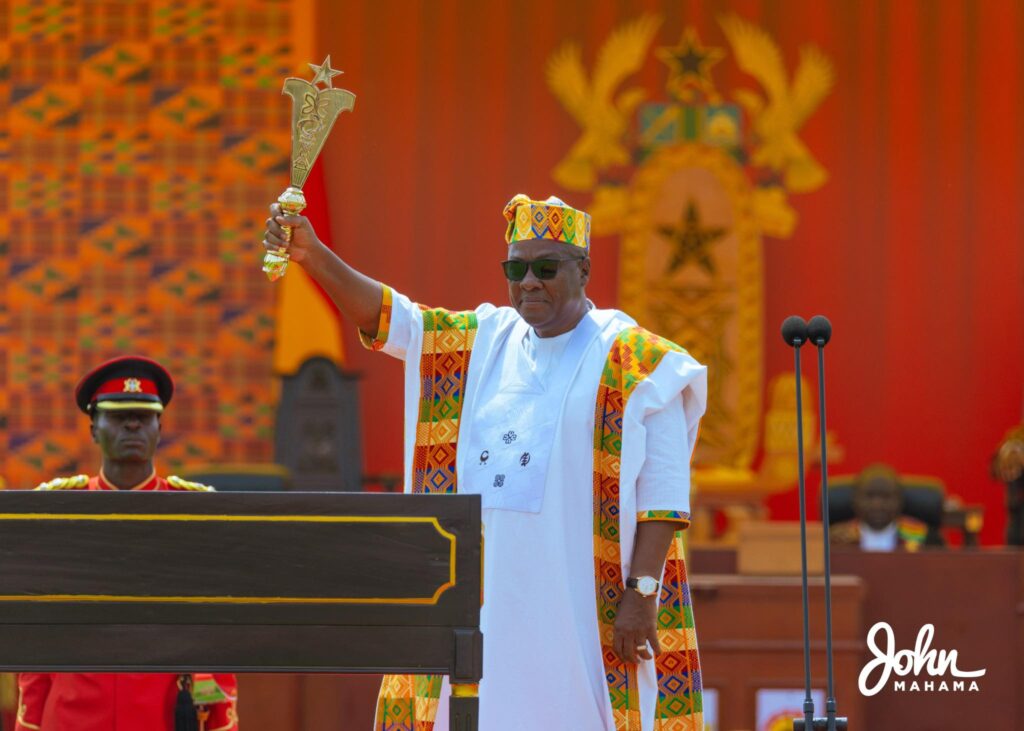
When he climbed the marble steps of Parliament and placed his hand on the Bible at Black Star Square, John Dramani Mahama was not simply resuming an office he had held before; he was inheriting a ledger written in months and decimals — inflation percentages, foreign-exchange blotches, debt maturities, the invisible taxes of daily life. The ceremony on 7 January 2025 read like a political novel’s turning point: crowds, protocol, the familiar face that many had once trusted and others had once rejected. Yet the real drama of a comeback plays out not in photographs but in balance sheets, in the slow accretion of institutional change, and in the weary arithmetic of ordinary citizens. The first year of this mandate has been both theatre and governance: speeches for the cameras, policies for the ledger — and politics for the long haul.
This journal aims to do something rare for political writing: to be both unforgivingly precise and provocatively generous. It addresses intellectuals who fear complacency, technocrats who dislike melodrama, and political opponents who prefer to count slogans rather than outcomes. It asks a blunt question: can a comeback presidency convert nostalgia into structural improvement — and, if so, how quickly — before the impatience of voters turns a mandate into a memory?
*The arithmetic that frames all rhetoric*
Ghana’s return to Mahama carried an electoral clarity that should have been a political asset. International monitors, post-election assessments, and IMF summaries noted a decisive result that handed the National Democratic Congress a working majority and political space to legislate. But while legitimacy matters, legitimacy alone does not pay for imports, reduce inflation, or rebuild investor confidence. The new administration’s first months were shaped by a core tension: how to display political authority while ceding enough headroom to technocratic fixes that, by definition, are slow and unspectacular.
This is not petty prudence. It’s the politics of scarcity. Macro indicators — from consumer prices to external balances — set constraints that determine what is feasible. With pressures on the currency and public finances, the presidency has, in practice, been forced into triage: calm inflationary expectations, shore up revenue, and protect the vulnerable. Each move tightens space elsewhere. A decision to defend the cedi with scarce reserves can raise borrowing costs. A clampdown on smuggling improves receipts but risks disrupting livelihoods and local economies that depend on informal trade. The year’s central lesson is simple: policy choices are not abstract moral claims; they have distributive consequences that unfold in markets, classrooms and hospital wards.
*Gold* *—* *the mineral that rewrites the budget*
If one resource has come to define the first year it is gold. Ghana’s recent policy turn to formalize and centralize gold trading — typified by the establishment of the Ghana Gold Board (GoldBod) and the inauguration of a national anti-gold smuggling task force — is not merely administrative theatre. It is an attempt to translate commodity price windfalls into public revenue and development capital. The government’s public account of record increases in official exports, and its rhetoric about traceability and value addition, show a deliberate strategy: close the leakage, raise the official yield, and use the proceeds for investment.
This is where the presidency can surprise both admirers and critics. To date, enforcement has been coupled with promises of a new industrial logic: ISO-certified assay labs, refined exports rather than raw dore bars, and localized manufacturing hubs. If these plans are executed with institutional integrity — transparent procurement, credible auditing, and attention to artisanal miners’ livelihoods — the result could be more than short-term fiscal buoyancy. It could seed local value chains that survive price cycles. If, however, these reforms are conducted as episodic crackdowns or as rent-capture opportunities for cronies, then legal gains will be ephemeral and political damage permanent.
There is also a subtler political implication. By moving deliberately into resource governance, the Mahama administration is changing the rules of patronage. Revenues that once flowed informally and unpredictably can be rechanneled into public goods, thereby shrinking the discretionary spoils that underpin clientelist networks. That is exactly the kind of structural shift opponents dislike — because it shifts the terrain of competition away from personalities and back toward institutions. It is also exactly the kind of structural shift a country needs if the mandate is to become a legacy.
*Monetary sovereignty,* *parliamentary muscle and the central bank*
A calmer price environment is politically salable; monetary credibility is politically valuable. One year in, the government has pushed to insulate monetary policy from short-term political pressures. Parliamentary moves to tighten the bounds of central bank financing — cutting legal avenues for direct deficit monetization and redefining emergency lending — are consequential. They signal to markets and multilateral partners a willingness to accept constraints in exchange for longer-term stability. But law is a guardrail only if institutions can enforce it; without transparent procurement, public audit, and accountable communication, independence may be statutory but hollow.
This is the intellectual challenge that should worry both the finance minister and the critic in the bar: how do you make independence not just a legal fiction but a daily, boring practice? The answer is painfully ordinary — better balance-sheet transparency, public reporting of auctions, robust internal governance at the central bank, and an empowered, independent audit office whose reports matter politically. These are not sexy reforms. They are infrastructural. And they are, in truth, the only durable weapon against episodic inflation surges that punish the poor.
*The IMF, international partners and the politics of conditionality*
The Mahama presidency has not shunned multilateral engagement; rather, it has used it as an instrument to signal seriousness while carving rhetorical space for national dignity. Engagements with the IMF and other lenders have yielded disbursements that buoy reserves and partially normalize markets. But working with the IMF is always a political tightrope — domestic audiences resent perceived external dictates even as markets demand them. The administration’s task is therefore to translate conditionality into domestically legible narratives: explain that short-term sacrifice buys medium-term room to invest in health, education and infrastructure. This requires more than press releases; it requires visible programs that citizens can point to in the market and the clinic.
Here is a word to Mahama’s opponents: if you are tempted to turn every IMF meeting into partisan theatre, be mindful of the arithmetic. Street anger at austerity is real — but so is the risk of chronic macro-instability that leaves no one well. The wiser political posture for opposition parties is to demand measurable social protections alongside fiscal adjustment — in other words, to be both opposition and co-guardian of national resilience. Surprise us: propose credible alternative instruments that stabilize without social ruin. The country will reward constructive opposition; rancour will be costlier.
*The human geography of policy — who gains, who loses*
Policies do not land uniformly. Urban households feel inflation in petrol and bread; rural families feel import compression in fertilizer prices and market access. Small-scale miners fear enforcement; artisanal communities fear loss of livelihood. The presidency’s response has been to promise layered, targeted interventions — subsidies for seed and fertilizer, support for artisanal miners to formalize, and social protection for the most vulnerable. Yet implementation remains the pivot on which public trust turns.
A provocation for policy makers: stop treating formalization as merely technical and start treating it as social design. Formalizing miners without a package of credit access, licensing simplification, and alternative livelihoods will criminalize poverty. A functional GoldBod — one that audits, buys transparently, and pays promptly — could be a model for how to transform informality into taxable, visible economic activity without pulverizing small communities. That is both a moral and pragmatic project.
*Politics of memory and the surprise of competence*
Several of President Mahama’s most eloquent moves are rhetorical: a reparations diplomacy that seeks moral leadership on a global stage, and a rhetoric of “reset” aimed at a public fatigued by austerity. The danger of rhetoric is twofold: it can raise expectations the state cannot meet, and it can harden opposition into perpetual scepticism. Yet rhetoric also has a catalytic role — if paired with procedural rigor it can socialize compromise. The surprising political move the presidency could make — and the one that would unnerve opponents — is to institutionalize competence rather than personalize it.
Imagine a presidency that, instead of celebrating anti-smuggling raids alone, publishes a rolling dossier of seizures, receipts, and transparent beneficiary lists for how recovered funds are spent. Imagine parliamentary committees with real investigative powers and public hearings visible on television. Imagine district assemblies receiving conditional transfers tied to audited progress on basic services. Those are small, technical reforms with outsize political returns: they make governance predictable, reduce corruption rents, and reframe political competition around delivery rather than distribution of spoils.
*A challenge to the intelligentsia*
To the intellectuals who read the Econmist and the policy wonks who read statistics: be audacious enough to offer uncomfortable counsel. Suggest tax reforms that widen the base even if they complicate party politics. Design social-insurance experiments that protect consumption while preserving incentives. Sketch bold proposals for platinum-grade public procurement transparency: public APIs for contract awards, independent e-procurement audit dashboards, civic monitors with legal standing. These are wonky, tedious things, but they are the connective tissue of a legacy.
Here is a sharper provocation: the presidency’s single greatest leverage may be its ability to refract public expectations toward long-term institutions. If the Mahama administration can show that a vote can translate into a measurable improvement in service delivery, then political competition in Ghana will gradually shift from identity and clientelism toward performance. Such a political realignment would be revolutionary precisely because it erodes the machinery of rent politics without bloodshed. Opponents who fear the loss of patronage may therefore find themselves defending a status quo that citizens increasingly resent.
*Where the mandate must not get lost*
A final set of cautions. First, enforcement without alternatives is policy cruelty. If the government insists on shutting down informal flows (gold, fuel, foreign exchange) it must simultaneously create pathways to formal inclusion. Second, legal safeguards must be real: central bank independence matters only if judicial and audit institutions can hold the powerful to account. Third, diplomacy — whether for reparations or trade — must be matched by domestic policy coherence: moral stances that ignore balance-of-payments realities are sermon without leverage.
This is not to argue for timid governance. It is to argue for audacious prudence: to act boldly where institutions exist, and to invest aggressively where they do not. To recast a cliché: politics without process is spectacle; process without politics is impotence. The Mahama mandate must learn to do both.
*The next chapter* : *indicators that will matter*
If the media and the markets are to judge fairly, they must watch a handful of indicators not for their own sake, but for what they reveal about policy architecture: sustained decline in inflation and volatility of the exchange rate; an increase in officially recorded gold exports and the share of refined (not raw) exports; improved public procurement scores; visible increases in district-level service delivery funded by audited transfers; and the presence of independent audits and parliamentary hearings that change behaviour. These are the metrics of an institutional legacy.
One year on, the presidency is not finished. It is simply entering the season where details matter more than rhetoric. This is the moment when the messy, unglamorous instruments of governance — audits, procurement portals, assay labs, conditional transfers, durable safety nets — will decide whether the mandate becomes a legacy or a footnote.
*A closing provocation to friends and foes alike*
To friends: stop prescribing nostalgia as a policy. To foes: stop assuming that every measure of competence is partisan trickery. And to the president himself: the most subversive, politically radical act you can perform in this era is to make governance boringly reliable. Build systems that outlive personalities; design transparency so complete that it becomes a public norm; and commit to measured, visible redistribution that is defensible in both the market and the village.
Surprise your critics by making them redundant: win them over not by rhetoric but by results that become obvious in the marketplace and the classroom. That is how mandataries become legacies.