
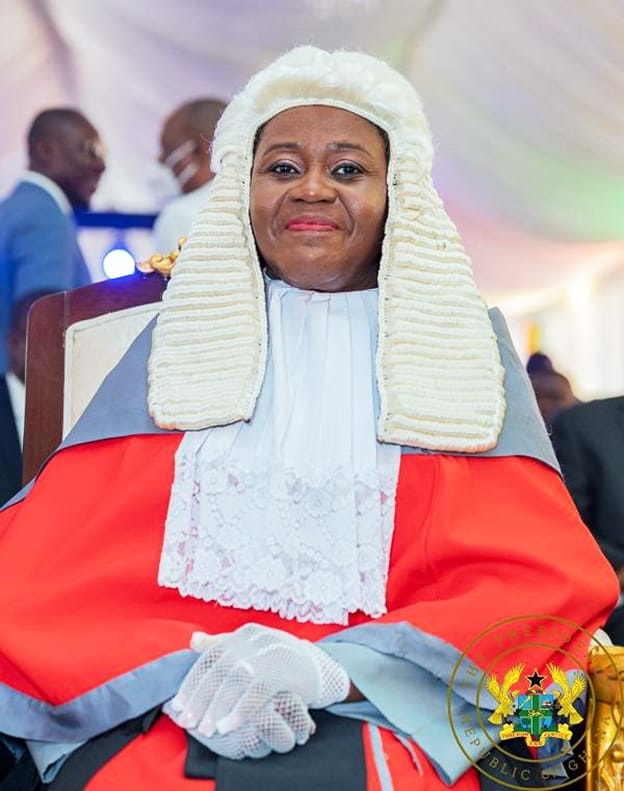
Ghana’s Chief Justice, Her Ladyship, Gertrude Torkornoo, has broken her silence on the ongoing Article 146 proceedings seeking her removal from office, describing them as “unconstitutional,” “misleading,” and “dangerously precedent-setting.” In a detailed response, she addressed each of the three petitions that have triggered the inquiry, claiming they are built on lies, misunderstandings of judicial procedure, and personal vendettas.
The Chief Justice emphasized that her responses to the petitions were submitted within seven days of receiving them and made publicly available online. Despite this, she said, public discourse has focused solely on the allegations, ignoring her documented rebuttals and evidence.
The Ofori Petition: “A Legal Misunderstanding Turned Personal”
The most extensive of the three petitions was filed by businessman Mr. Daniel Ofori. The Chief Justice clarified that only two of his allegations involve him personally, both regarding the transfer of his cases between judges.
According to her explanation, one case was transferred because the original judge faced a family emergency and had to leave the country. The second case, closely related to the first, was assigned to the same replacement judge as per established court policy that mandates similar cases be consolidated under one judge. “There is no basis or truth to the allegations that I had any personal interest,” she stated.
Highlighting the strained relationship between her and Mr. Ofori, she noted that she had previously written a dissenting opinion in one of his Supreme Court cases — which he won, despite her stance. Since then, his legal team has requested that she not sit on any of his cases, and she has complied.
“What Mr. Ofori’s allegations seem to suggest is that a court user can demand the removal of a Chief Justice simply because a decision did not go their way,” she argued.
The Chief Justice also dismissed Mr. Ofori’s accusations of financial misconduct. These included claims of misappropriating travel funds and per diem allowances for her family. She explained that her conditions of service explicitly allowed her to travel with a companion for security reasons and that travel expenses and per diems are set by Judicial Service policy — not by her discretion.
“No ticket was bought by me. No per diem was issued by me. And the records show I accounted for the funds appropriately,” she said.
Other complaints in Mr. Ofori’s petition, such as staff transfers and historical appointments made before she assumed office, were labeled irrelevant and baseless. “He even holds me accountable for actions taken before my appointment as Chief Justice in June 2023,” she added.
Akolgo Petition: “A Contradiction in Itself”
The second petition came from Mr.s Ayamga Akolgo, who alleged that he was unlawfully arrested in court after a Supreme Court ruling went against him. However, the Chief Justice pointed outs that Mr. Akolgo’s own exhibit — a media report — contradicts his claim, stating he was escorted out after disrupting proceedings.
“What is troubling,” she noted, “is that Justice Pwamang, who sat on the same panel and is named by Mr. Akolgo as a witness, is now chairing the committees investigating my conduct.” She argued that this presents a clear conflict of interest.
The Chief Justice further cited Article 127(3) of the Constitution, which indemnifies judges from lawsuits based on judicial actions. “Yet, I am being tried for exercising judicial power, in violation of this constitutional protection.”w
Shinning Stars Petition: A Ghost Complainant?
The third petition was filed by a group calling itself “Shinning Stars”, which the Chief Justice noted is unregistered and of uncertain legitimacy. The group’s complaint concerns a ruling in the Afenyo-Markin v. Attorney General and Speaker of Parliament case, claiming she failed to allow the Speaker of Parliament to be heard.
“Supreme Court decisions are made by a panel, not by a single judge,” she stressed. “And I was only one of five judges who sat on that case.”
Undermining the Judiciary: A Dangerous Precedent
In her closing remarks, the Chief Justice warned of a broader threat to judicial independence if the proceedings against her continue unchecked.
“If this nation descends into closed-door proceedings that break all the rules of adjudication and inquiry, it will lead us to a place where no judge or head of an independent constitutional body will be safe from intimidation or removal,” she said.
Quoting German Pastor Martin Niemöller, she reminded the nation of the danger of silence in the face of injustice:
“Then they came for me – and there was no one left to speak for me.”
The Chief Justice maintained that no one can truthfully accuse her of ever accepting a bribe. “This is the personal treasure of integrity that I live with.”
Despite disagreeing with the legality of the process, she says she has respected the President’s suspension warrant and continues to honor the proceedings — though she does not hide her belief that they are “being carefully staged to result in [her] removal, even without lawful justification.”
A Call for Judicial Fairness and Constitutional Respect
She concluded with a plea to uphold the rule of law, protect judicial independence, and reject the use of “smear campaigns” and “inquisition-style” panels as tools to oust judicial officers.
“Let the law and the Constitution — not political convenience — guide this nation,” she said.