
A Reflective Field Note by Richard Dablah
Email: richard.dablah@gmail.com
Drains flow ceaselessly, even on bone-dry days in Accra’s dense peri-urban corridors.
This persistent sight—murky water trickling through concrete channels under cloudless skies—unmasks a profound dysfunction at the nexus of technology, infrastructure, and governance. In Ghana’s capital, where over 2.5 million residents navigate rapid urbanization amid limited sewerage, the Greater Accra Metropolitan Area (GAMA) Sanitation and Water Project (2015–2025) marked a pivotal intervention. Deploying thousands of Biofil on-site sanitation units, the initiative targeted unserved households, delivering private flush toilets with tiled chambers and functional digesters. Families abandoned shared pit latrines and interminable queues, gaining dignity, privacy, and basic hygiene upgrades. Installation rates soared, with GAMA reporting over 20,000 units by 2024, a tangible win in a city where only 3% of wastewater historically received treatment.
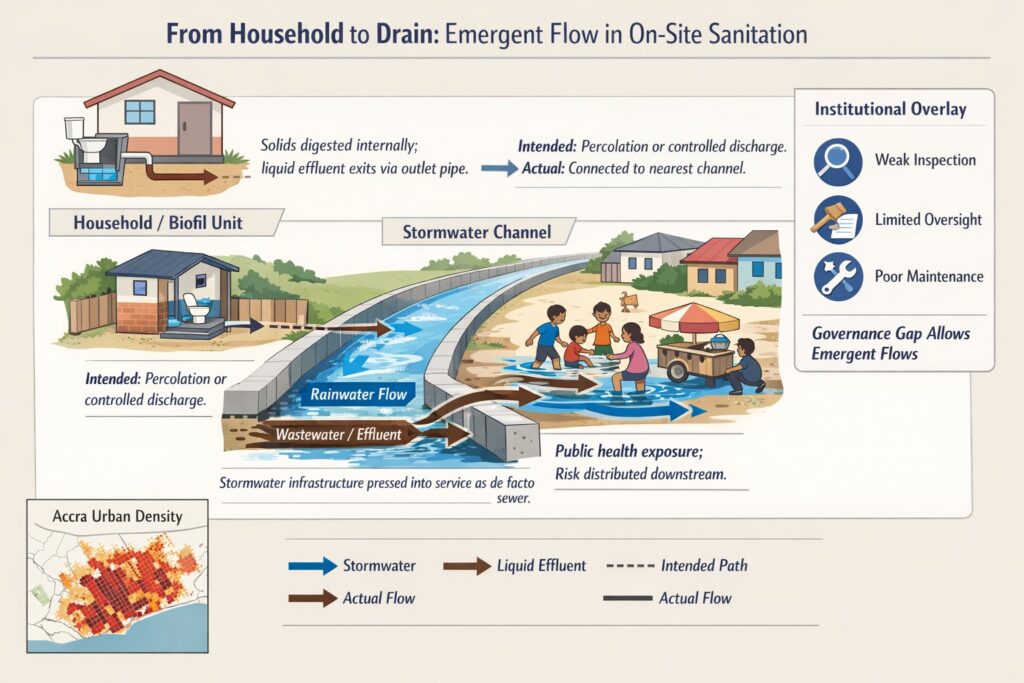
Yet success at the household scale belies systemic fragility. Biofil systems—composting toilets with anaerobic baffled reactors—partially treat fecal sludge on-site. Solids undergo microbial digestion in sequential chambers, reducing volume by 60–70% and stabilizing pathogens over 20–30 days of retention. Liquid effluent, comprising 80–90% of input volume, emerges partially clarified but laden with residual organics (BOD ~100–200 mg/L), nutrients, and viable pathogens (e.g., E. coli >10^4 CFU/100mL). Design specifications mandate soil percolation via infiltration trenches or conveyance to designated soakaways. In Accra’s reality, however, effluent pipes snake toward the nearest stormwater channel—open drains engineered solely for episodic rainfall runoff.
This diversion births “de facto sewerisation.” Channels, spanning Accra’s low-gradient topography, now pulse with continuous, malodorous flows. Discoloration (grey-brown hues), foam, and putrescence signal untreated wastewater intrusion. On dry days, baseflow persists at 0.5–2 L/s per channel reach, orders of magnitude above natural groundwater seepage. During rains, dilution masks but does not neutralize contaminants; first-flush events mobilize sludge deposits, disseminating pathogens into streets, markets, and homes. The infrastructure endures—channels neither collapse nor fully clog—but its hydrological mandate erodes, amplifying flood risks and environmental degradation.
Biofil units themselves perform admirably in isolation. Field audits confirm solids digestion efficiency (VS reduction >50%), chamber hygiene (no overflows, minimal odors), and user satisfaction (>85% in GAMA surveys). Effluent exits via standardized 50–75mm PVC outlets. The rupture occurs downstream: impermeable lateritic soils, high water tables (1–2m in rainy seasons), and spatial squeeze in 5x5m compounds compel connections to open drains just 2–10m away. Absent enforcement, households prioritize functionality over protocol. Household-level technology succeeds; metropolitan-scale sanitation falters through unmonitored externalities.
Waste management practitioners worldwide must dissect these fault lines:
**1. Techno-Governance Disconnect**
Biofil’s engineering—baffled flow, pH buffering (7.5–8.5), and anaerobic consortia—delivers reliable partial treatment. Yet sustainability demands more than hardware. Effluent quality falls short of WHO guidelines for unrestricted discharge (BOD <50 mg/L, fecal coliforms <10^3/100mL), necessitating secondary handling. Accra’s rollout prioritized units over ecosystems, omitting soil permeability tests, channel capacity modeling, or lifecycle costing. Practitioners must embed contextual diagnostics—hydrogeology, density mapping—from feasibility stages, treating sanitation as socio-technical ensembles rather than discrete artifacts.
**2. Externalized Public Health Vectors**
Effluent infiltration in public realms cascades exposures. Children wade channels during play; vendors rinse produce in drain-fed troughs; monsoonal floods aerosolize and infiltrate homes. Analogous outbreaks—cholera spikes post-2014 floods, hepatitis A in informal settlements—trace to fecal coliforms exceeding 10^6 MPN/100mL in surface waters. Risk modeling reveals 5–10x amplification when channels hybridize. Siting protocols must integrate receptor mapping: proximity buffers (>20m), exposure gradients (schools, markets), and dilution factors.
**3. Unintended Hybrid Infrastructure Loading**
Accra’s 1,200+ km of open channels, graded for 1:50-year storms, silently accrue chronic sewage loads (estimated 5,000–10,000 m³/day diverted). Biochemical oxygen demand depletes dissolved oxygen, fostering anoxia and eutrophication downstream in Korle Lagoon. Sediments accumulate helminth ova, resuspending during flows. This repurposing erodes resilience: channels lose conveyance (20–30% siltation) while gaining pollutant sinks. Urban growth—Accra’s population doubling by 2030—demands fused paradigms, modeling combined hydrographs and pollutant budgets.
**4. Supervisory and Institutional Capacity Lags**
GAMA scaled installations 10x faster than inspectors could verify (1:500 unit ratio). Siting guidelines exist, but enforcement wanes amid 200+ informal connections monthly. Field teams note 40–60% non-compliance in high-density zones like Agbogbloshie. Remediation requires tiered oversight: installers certify pathways, municipalities audit quarterly, and regulators sample biannually. Digital tools—GIS-tagged photos, effluent loggers—could scale verification without ballooning costs.
**5. Systems Diagnostics Beyond Hardware**
When contamination surfaces (e.g., 2023 diarrheal upticks), scrutiny fixates on toilets, not flows. True diagnosis traces contaminants: generation (per capita 50–100 L/day), digestion (60% volume reduction), routing (channel diversion), and receptors (lagoon biota). Vulnerability nodes emerge at interfaces—soil rejection, pipe misconnections—demanding chain-wide metrics.
Accra’s dynamics replay globally: Nairobi’s flying toilets clog matatus; Lagos’ on-site pits overflow into lagoons; Mumbai’s soak pits fail in monsoons. Dakar and Dar es Salaam mirror Biofil-like deployments, with 30–50% effluent diversion documented. A 2024 meta-analysis flags similar “sanitation silos” in 70% of low-service cities.
Actionable pathways for sustainable practice:
– **Integrated Site Selection**: Mandate tripartite assessments—geotechnical (Ksat >10^-5 m/s), hydraulic (channel dilution >20:1), exposure (buffers, floodplains)—pre-installation.
– **Enforceable Effluent Protocols**: Standardize audits: visual (flow path), grab-sample (BOD, coliforms), volumetric (flow meters). Penalize diversions >GH₵500/unit.
– **Community-System Synergies**: Co-design education via local assemblies, emphasizing dry-flow observation as sentinel metric. Train 10% households as “sanitation stewards.”
**Data Infrastructures for Adaptation**: Deploy low-cost sensors (pH, turbidity) at 100 channel nodes; crowdsource photos via apps. Build dashboards linking flows to health data.
**Policy-Technical Harmonization**: Elevate effluent to national standards (Ghana EPA), funding secondary treatment (constructed wetlands) for 20% high-risk channels by 2030.
Biofil stabilizes solids robustly—pathogen die-off >3-log, sludge volumes halved—yet metropolitan viability pivots on governance sinews: enforcement density, institutional memory, infrastructure interoperability. Absent these, channels devolve from stormwater spines to waste arteries, eroding gains in circularity.
Accra embodies sanitation’s chain reactions: digestion efficacy hinges on routing fidelity, which governance fortifies, which environments absorb. One fracture contaminates afar—Korle Lagoon’s fisheries collapse, beach tourism’s pall.
GAMA’s hygiene dividends endure, but channel overloading indicts fragmented stewardship. Risk appraisal, adaptive monitoring, and cross-sector pacts form the bedrock of sustainability.
Persistent dry flows whisper imperatives: trace effluents, regulate rigorously, sustain holistically. Urban waste stewards—from field operators to policymakers—must heed Accra’s channels, lest their cities’ drains run foul tomorrow.