
By Richard Dablah
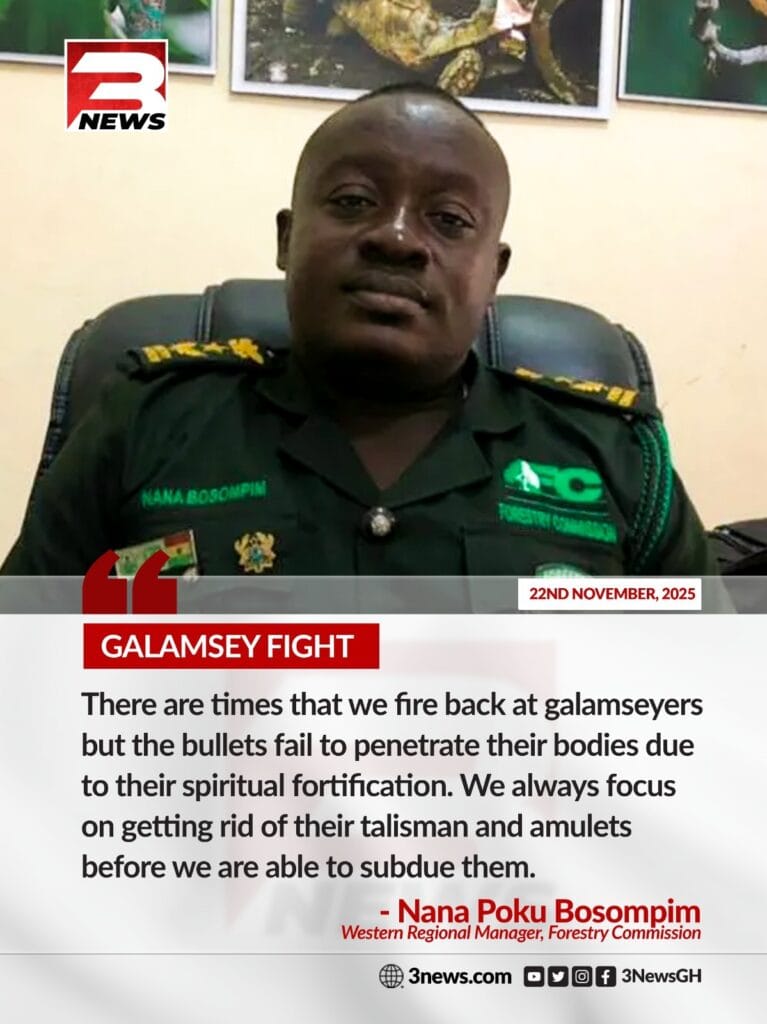
There are moments in a republic when the line between governance and folklore dissolves so completely that one wonders if the nation is being ruled by a cabinet or a coven. This week delivered such a moment. A senior state official, uniform starched, badge polished, voice solemn, declared to a national audience that bullets sometimes refuse to penetrate the bodies of galamseyers because the miners possess spiritual fortification. The problem, he insisted, is not poor tactics or bad equipment. The problem is amulets. In other words, the Forestry Commission is fighting metaphysics with automatic weapons.
This is not satire. This is Ghana.
The statement would be funny if it did not echo a deeper national pattern: our uncanny ability to smuggle cosmology into modern governance. We do not simply coexist with the supernatural. We legislate with it. We plan policy with it. We police with it. When bullets fail, we blame dwarves. When revenue disappears, we blame spirits. When corruption spreads, we observe a fast. This is a country where the border between parliament and prayer camp is porous, where technocracy competes with prophecy, and where the state occasionally behaves like a frightened apprentice in a village shrine.
To dismiss this as primitive would be too easy and also lazy. What we are witnessing is a collision between two cosmologies. One is the world of modern institutions that demand causal explanations, measurable outcomes, and rational accountability. The other is the world that sees the universe as an active theatre filled with unseen forces that guide, protect, and occasionally sabotage human efforts. The Forestry Commission officer is not an outlier. He embodies this unresolved tension.
It is the same tension that led respected pastors to gather and pray for the cedi as though macroeconomic stability were a demon to be cast out rather than the predictable outcome of sound fiscal discipline. It is the same tension that sent national leaders to the Akosombo Dam to pray for rain during an energy crisis, as if hydrology were a matter of divine mood rather than climate patterns, water inflows, and infrastructural planning. We prayed over the turbines. We prayed over the reservoir. We prayed as if standing at the edge of the dam, shouting into the wind was a legitimate alternative to a long-term energy strategy.
This blending of sacred and secular would be charming if it were not so politically costly. It turns governance into ritual performance. It replaces planning with invocation. It invites citizens to outsource agency to invisible forces. Worst of all, it encourages institutions to excuse failure by attributing it to cosmic forces as the cause. If bullets fail to penetrate, we do not question the quality of the weapons or the team’s competence. We blame talismans. If the cedi collapses, we do not blame policy. We blame demons. If the lights go off, we do not demand structural investment. We demand prayer.
This is not spirituality. This is escapism.
Philosophically, the more troubling issue is what this worldview does to the idea of a modern state. A state is built on the premise that cause and effect can be explained, predicted, and controlled. When a state begins to attribute operational failure to supernatural resistance, it undermines its own authority. It becomes a participant in myth rather than an arbiter of reality. The state becomes a storyteller rather than a problem solver. The political imagination retreats into the comfort of the irrational because the rational demands responsibility.
What is fascinating is that no one seems to notice the irony. We are a country equipped with satellites, biometric systems, forensic labs, energy models, predictive analytics, and hydrological data, yet our public discourse still flirts with Bronze Age explanations. Ghana’s challenge is not that people believe in the supernatural. People everywhere do. The challenge is that our institutions increasingly behave as if superstition is an official framework for governance.
There is a reason advanced societies compartmentalize metaphysics. They keep the sacred in the private realm and reserve the public sphere for evidence-based reasoning. Not because they hate spirituality but because governance cannot run on miracles. Miracles have no budget. Miracles cannot be audited. Miracles cannot be planned. Miracles cannot be scaled. Miracles are, by nature, unreliable. Nations cannot be built on the unpredictable.
The satirist in me wants to laugh. The citizen in me cannot. When a state official claims bullets bounce off bodies because of charms, he is not merely describing an odd incident. He is signaling an epistemic breakdown. If the state believes amulets can stop bullets, why would the state invest in body armor? If the state thinks prayer can fix an economy, why would the state pursue reform? If the state believes rain comes from prophets, why fund climate adaptation?
The philosophical question is simple. How does a country modernize its infrastructure when its imagination is stuck in the pre-modern era? The political question is sharper. How does a democracy hold leaders accountable when leaders can invoke the supernatural to explain failure? The satirical question is irresistible. If bullets fear amulets, should the Ministry of Defense revise its procurement plan and acquire holy water instead of armored vehicles?
Somewhere between these questions lies the truth. Ghana is trapped in a fascinating contradiction. We want the fruits of modernity without its disciplines. We want the sophistication of a global economy with the comfort of cosmic explanations. We want a twenty-first-century state built on a first-century cosmology.
It makes for great comedy. It makes for terrible governance.
Until we confront this cognitive dual citizenship, we will remain a nation that prays at dams, exorcises currencies, and blames talismans for tactical failures. The tragedy is not that people believe such things. The tragedy is that our institutions are beginning to accept them too.
The result is a republic that cannot always distinguish between public policy and public spectacle. A republic that sometimes behaves like a theatre. A republic where officials fight metaphysical miners with state-issued rifles and seem surprised when the rifles lose. A republic that wanders between science and superstition and calls the confusion culture.
The future belongs to nations that master reality. Ghana must decide if it wants to be one of them