
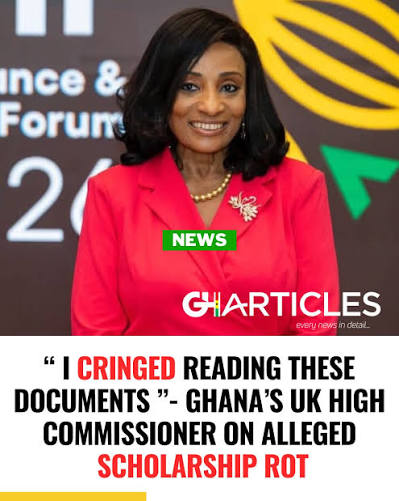
by Richard DABLAH
Ghana’s latest scholarship controversy has been reduced, predictably, to a morality tale about public money: questionable awards, family members travelling with beneficiaries, unpaid stipends and officials pointing fingers. Yet the scandal is more revealing than the individual cases now attracting attention. It exposes something more fundamental: *a state increasingly unable to distinguish public investment from private entitlement.*
Reports from Britain allege that substantial sums were committed to some scholarship beneficiaries and their dependants, while legitimate Ghanaian scholars have endured prolonged delays in stipends and other obligations. The accumulated liabilities have reportedly reached tens of millions of pounds.
The paradox should trouble anyone interested in governance. How can a state simultaneously spend beyond its means on some beneficiaries and fail to honour commitments to others? The answer cannot simply be corruption. Corruption describes the deviation. It does not explain the architecture that permits it.
A scholarship is supposed to be a national investment. The state finances education abroad because it expects knowledge, expertise and eventually a return to society. But an investment requires accounting. Who was selected? On what criteria? What did the programme cost? Who authorised the expenditure? What obligations were created? What did Ghana receive in return?
A competent state should be able to answer these questions almost instantly.
If it cannot, then the problem is larger than misappropriation. *It is a failure of institutional intelligence.*
The temptation will be to identify the individual who approved an irregular payment and demand punishment. Necessary perhaps, but insufficient. If an expenditure was contrary to the rules, who failed to enforce those rules? If it was permitted, who designed such rules? And if officials possessed discretion without effective oversight, why should the next administration behave differently?
This is where Ghana’s anti-corruption debate repeatedly becomes superficial. The country hunts for corrupt personalities while leaving intact the institutional arrangements that make discretion politically valuable.
The most disturbing victims may therefore be the students who did everything right. A young Ghanaian who won a scholarship through merit should not discover that the state has money for questionable expenditure but not for the obligation it owes them. Such contradictions do more than create hardship. They corrode the meaning of merit itself.
Once citizens conclude that access to public resources depends less on qualification than on proximity, networks or discretion, a scholarship ceases to be merely an educational instrument. It becomes a miniature model of the political economy.
That is why this controversy should not become another partisan contest. The relevant question is not which government should be blamed. It is why successive governments inherit institutions in which the same failures can recur.
Ghana needs to know, in auditable form, every scholarship awarded abroad, every contractual obligation created, every dependant covered, every payment made and every expected national return. Public money cannot be governed through administrative memory, political influence or scattered paperwork.
The deeper scandal is therefore not that some scholarships may have been abused.
It is that *the Ghanaian state may not possess sufficient institutional capacity to know, in real time, what its own scholarship system is doing.*
A country that cannot account for the money it spends developing its human capital risks turning merit into patronage and investment into entitlement.
The question confronting Ghana is consequently much harder than who should be punished?
It is this:
*Can a state that cannot reliably account for its scholars credibly claim to be investing in its future?*