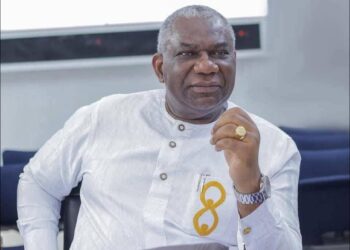
The Member of Parliament for Dormaa East, Paul Apraku Twum Barimah, has advised the Auditor General to computerize or digitalize the Assets declaration process to streamline the practice and capture all civil and public servants, including political appointees in a bid to enhance the fight against corruption.
In accordance with Article 286 of the 1992 Constitution, Some Public Office holders are mandated to submit their completed Assets Declaration Forms to the Auditor General’s office, but many have been adamant and other slow to respond.
Paul Twum Barimah indicated that computerizing or digitalizing the assets declaration process would help to save time, resources, manpower, preserve the integrity of information submitted and captured, and bring efficiency in information and assets tracking and tracing and service delivery. It will also help the nation seal holes and leaks that encourage corruption and save the nation millions of cedis it loses corrupt activities.
Honorable Twum Barimah made this known over the weekend when he interacted with a section of the media regarding the progress being made by the Akufo Addo government in the fight against corruption.


According to him. Computerization of the assets declaration process will help responsible state institutions to capture and track properties owned by state officials and monitor their lifestyles in terms of their purchasing influence.
Mr. Twum Barimah also urged the Auditor General to be proactive and approach state official to demand their assets and not wait for them (state officials) rather to walk to the Auditor General’s office to declare their assets. The Auditor General must go to them and demand that they declare their assets if they are not willing to do the right thing, he stated
Article 286 of the 1992 constitution requires the President of the Republic of Ghana, the Vice-President , Speaker, Deputy Speaker and members of Parliament; Ministers of State and Deputy Ministers to declare their assets
It also requires the Chief Justice, Justice of the Superior Court of Judicature, Chairmen of the Regional Tribunal, Commissioner for Human Rights and Administrative Justice and his deputies and all judicial officers; Ambassadors and High Commissioners, Secretary to the Cabinet, Heads of Ministries and government departments or equivalent office in the Civil Service; chairmen, managing directors, general managers and departmental heads of public corporation or company in which the State has a controlling interest to declare their assets.
Others include the Governor of the Bank Of Ghana and his deputies Chairperson of the Electoral Commission and his or her deputies, Chairperson of the National Commission for Civic Education and his or her deputies ,Head of Chancery of Ghana Embassy or Ghana High Commission and Heads of Departments of Bank of Ghana Officers in the Armed Forces seconded to civilian establishment and institutions , Members of the Tender Boards of the Central, Regional and District Assemblies and Officials of Vehicle Examination and Licensing Division (VELD) not below the rank of Vehicle Examiner .
The rest are Presidential Staffers and Aides , Officers of the rank of Assistant Inspector of Taxes and above in the Ghana Revenue Authority or equivalent Officers of the Police Service Officers of the Prison Service , District Chief Executives , Presiding members and secretary of Metropolitan, Municipal and District Assemblies ; Chairperson of the Public Services Commission and his Deputies, Head, Office of the Civil Service , Persons who are Heads of departments that’s Accountants , Internal Auditors in; Procurement Officers and Planning and Budget officers in finance and procurement departments of government ministries, departments and agencies, District, Municipal and Metropolitan Assemblies, and any officer in any other public office or public institution other than the Armed Forces the salary attached to which is equivalent to or above the salary of a Director in the Civil Service.
According to a World Bank research, Enhancing Government Effectiveness and Transparency, over 160 countries around the world have introduced financial disclosure systems. Asset declaration systems differ in scope and reach, level of sophistication and transparency. Countries use different institutional setups and methods to enforce the disclosure rules and verify information. However, the analysis shows a clear trend of asset declarations becoming a universal instrument to enhance public sector transparency and accountability, promote integrity and prevent corruption.
Asset declaration systems have increasingly become a multipurpose tool aimed at preventing conflicts of interest, detecting unjustified assets and building broader integrity of public service. Asset declarations, therefore, combines prevention and enforcement purposes. New combined systems are replacing traditional ones, which often treated disclosure of assets and interests separately and pursued different objectives. Countries introduce or bolster verification mechanisms to improve enforcement. Asset declaration systems also raise heated debates, especially concerning public disclosure of information from the declarations. It is a prominent example of how countries balance considerations of privacy and personal security with the public interest in transparency and accountability.
With more systems becoming digitized and going online, asset and interest declaration (AID) contributes to the development of digital governance and economy. Electronic systems of disclosure have a spillover effect by encouraging civil society and media that use data on the assets and interests of public officials in their watchdog activities.