
by Richard DABLAH
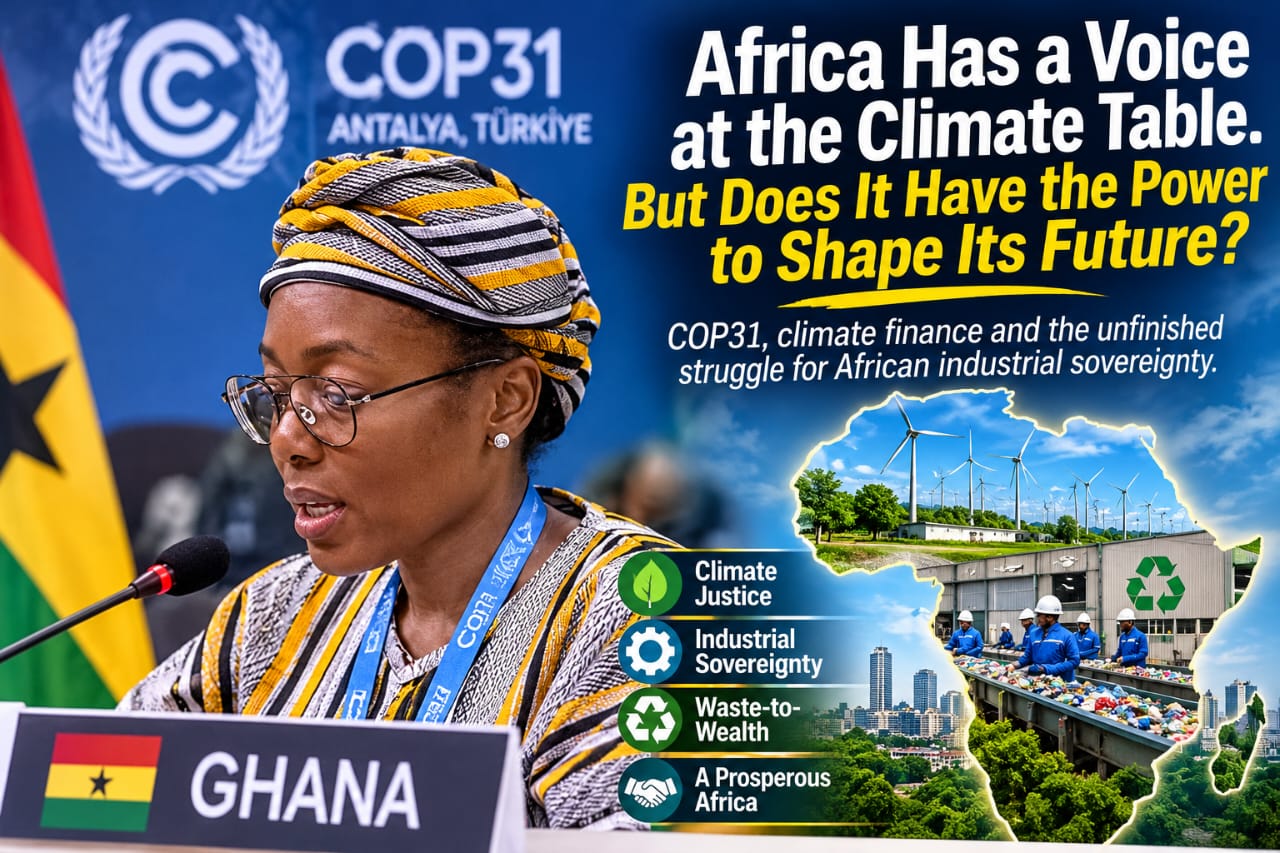
COP31, climate finance and the unfinished struggle for African industrial sovereignty.
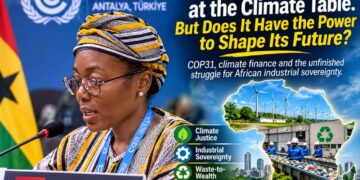
When Ghana’s Environment Minister, Dr Zanetor Agyeman-Rawlings, was interrupted while delivering the African Group’s statement at COP31’s closing plenary in Antalya, the moment became a test of diplomatic respect. The African Group’s chair invoked the conference’s code of conduct; the minister resumed and completed her intervention; and the COP president later apologised. The episode matters less for the apology than for the question it exposes: what does it mean for Africa to possess a voice in climate negotiations while lacking comparable power over the finance, technology and industries shaping the transition?


The distinction matters because the interruption was procedural; the inequality is structural. Under the United Nations climate process, states participate as sovereign parties. Yet they arrive with radically unequal financial resources, scientific institutions, negotiating capacity, technological ownership and ability to withstand economic shocks. Equal standing does not confer equal influence over investment, patents, commodity prices or infrastructure finance. Representation is not power; recognition is not ownership.
COP31 made that contradiction visible in its substantive outcome. The conference produced progress in several negotiated areas, including just transition, climate finance and adaptation. But governments failed to agree on the presidency-led cover decision, after divisions over fossil fuels and the adequacy of the proposed political text. The United Nations described the failure as a significant setback, while noting that other decisions had been reached. The African Group acknowledged shortcomings in climate finance, loss and damage and just transition, but said it would not stand in the way of consensus. This was not simply Africa being defeated or silenced. It showed how limited compromises coexist with unresolved structural disputes.
Consider adaptation finance. For African countries, adaptation is not an abstract environmental undertaking. It means protecting harvests against drought, securing water supplies, strengthening flood defences, building resilient roads and safeguarding communities whose livelihoods depend on increasingly unpredictable weather. These investments protect production and resilience. A flooded road interrupts trade, raises transport costs and isolates farmers. A failed harvest affects employment, food prices, incomes, public revenue and debt repayment. Climate damage is economic damage.
Yet the financing debate exposes a profound injustice. Countries with limited fiscal space may have to borrow to protect themselves against climate impacts they contributed relatively little to causing. Loans may suit commercially viable energy projects, but are harder to justify for protecting vulnerable communities, restoring ecosystems or responding to irreversible loss. A solar plant that sells electricity is not financially equivalent to a village displaced by flooding. Treating both as bankable investments confuses financial return with public necessity.
Africa must therefore ask more exacting questions than how much climate finance has been announced. Is the money new and additional? Is it a grant, a concessional loan or commercial debt? Who sets the conditions? How quickly can vulnerable countries access it? What share reaches local institutions and communities? And does the financing expand productive capacity or simply add liabilities? At COP31, parties did not settle the baseline and quantified pathway for the call to triple adaptation finance by 2035. That is not bureaucratic trivia: it determines what counts as progress and who can be held accountable.
But the deeper question is not only who pays for climate action. It is who owns the economy that climate action is creating.
The low-carbon transition is expanding demand for minerals, batteries, electricity networks, recycling and advanced manufacturing. Africa has important mineral resources, but resource possession is not industrial ownership. If the continent exports raw materials, imports processed inputs and purchases finished technologies at prices determined elsewhere, it may supply the green economy without becoming one of its principal beneficiaries. The energy transition could then reproduce familiar patterns of unequal value capture under a more appealing environmental vocabulary.
This is not a claim that today’s green economy is identical to colonial extraction. The mechanisms differ, but the historical warning remains: political independence did not automatically dismantle commodity dependence, technological reliance or external control over high-value production. Supply chains, financing arrangements, intellectual-property rules and purchasing power can preserve unequal relationships without reproducing colonial administration. The question for African governments is whether they will negotiate access to markets alone, or also negotiate the capacity to process, manufacture, repair, innovate and own.
A just transition in Africa cannot be reduced to compensating fossil-fuel workers or installing renewable-energy equipment. It must include the ability to industrialise, expand reliable electricity, develop technical skills, build regional supply chains and retain a greater share of the value generated from African resources. Climate ambition should not become a new restriction on development for countries whose industrialisation came later. Nor should historical injustice excuse the destruction of forests, rivers or public health. The challenge is to build productive economies within ecological limits.
Ghana illustrates both the tension and the opportunity. It needs reliable, affordable power for manufacturing, mineral processing, agriculture and modern services. It must also confront illegal mining, forest loss, polluted waterways and weak environmental enforcement. They are not competing agendas. The test is whether environmental protection becomes a productive advantage rather than another cost imposed on an already constrained economy.
One underdeveloped opportunity is the waste economy. Discarded plastics, organic residues, used tyres, electronic equipment and industrial by-products are often treated primarily as sanitation problems. Some can become feedstock under the right conditions. Organic waste can support composting or biogas; sorted plastics can supply recyclers and manufacturers; selected industrial residues can substitute for virgin inputs. Recovery can reduce pollution while creating firms, jobs and supply chains.
But romanticising waste is no better than ignoring it. Not every material is economically recoverable. A viable industry requires dependable collection, sorting, quality standards, processing technology, reliable volumes, buyers and commercially realistic prices. Policy must enable investment without pretending climate benefits guarantee profitability. The point is larger than any single enterprise: environmental policy should help establish productive systems that retain material value, not merely pay indefinitely to move discarded materials from one place to another.
This is where Ghana’s diplomatic role should acquire a domestic test. As chair of the African Group of Negotiators, Ghana has a platform to connect continental climate demands with an industrial agenda. It can press for debt-sensitive finance, technology partnerships, regional processing and manufacturing, and investment in adaptation infrastructure. But its credibility will also depend on what happens at home: whether environmental laws are enforced, whether public investment is well governed, and whether private firms can build viable businesses around cleaner production and resource recovery.
The next round of negotiations should be approached with more than declarations of vulnerability. Africa needs costed investment priorities, regional manufacturing strategies, credible project pipelines, transparent financing requirements and measurable plans for local value addition. Its bargaining position will be stronger when countries coordinate markets, develop technical institutions and demonstrate that finance can be converted into productive assets.
The interruption in Antalya was resolved by an apology. The interruption of Africa’s industrial transformation will not be. It requires a different relationship with capital, technology, trade and ownership. The continent does not need merely a louder voice at the climate table. It needs the productive capacity to shape what is built after the negotiations end. The measure of climate justice cannot be how often African representatives are allowed to speak, but whether their countries gain the means to finance, manufacture, innovate and determine more of their own economic future.