By Ernest Addo
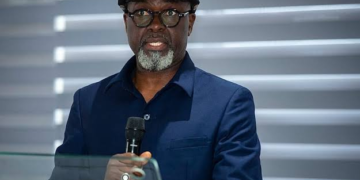
Chairman of the New Patriotic Party (NPP) Manifesto Committee on Education, Prince Hamid Armah, PhD, has painted a gloomy picture of the future of the Free Senior High School (SHS), a government transformative educational initiative aimed at expanding access to secondary education across the country, under a potential John Mahama-led National Democratic Congress (NDC) government.
“His evolving rhetoric, driven by political convenience rather than a sustained commitment to educational reform, raises questions about his credibility. These inconsistencies suggest that Mahama may lack the necessary conviction to oversee such a transformative policy, undermining public confidence in his ability to ensure its sustainability,” the former National Council for Curriculum and Assessment (NaCCA) boss argued.
In a scholarly paper (published) which examined former president Mahama’s discordant position on Free SHS, the social research consultant, who is also the deputy minister of Works and Housing posited that “John Mahama’s inconsistent stance on the Free SHS policy raises serious concerns about his ability to manage and sustain the programme effectively if re-elected.”

From his initial rejection of the policy as financially unfeasible and politically expedient, to his later attempts to claim credit for its inception under the Progressive Free Education initiative, the educationist asserted that “Mahama’s evolving position highlights a lack of steady commitment to one of Ghana’s most important educational reforms. His promise in the 2024 manifesto to review the policy, while framed as an effort to improve infrastructure and quality, is seen by many as politically convenient rather than a genuine belief in Free SHS’s long-term benefits.”
The Member of Parliament (MP) for Kwesimintsim constituency in the Western region, therefore cautioning that the NDC flagbearer’s promise to review Free SHS should be viewed with scepticism.
“His historical opposition, coupled with the political motivations behind his recent shift, casts doubt on whether he would genuinely prioritize the programme’s sustainability and effectiveness. The frequent changes in his position undermine confidence in his ability to manage Free SHS in a way that ensures it continues to serve the educational needs of Ghanaians. Without a clear and consistent commitment to the policy, Mahama’s leadership on Free SHS may lead to further instability and challenges,” he intimated.
Read below excerpts of Dr. Armah analysis of for president Mahama’s position shifting on the free SHS from 2012:
Initial Rejection (2012 Campaign)
John Dramani Mahama and the National Democratic Congress (NDC) were vocal critics of the Free SHS policy during the 2012 election campaign. Mahama famously dismissed the proposal as a “whimsical promise” and “unrealistic,” arguing that it was not financially feasible and would lead to the collapse of the education system (GhanaReporters.Com, 2014; Assel, 2012). He claimed that the NPP’s plan lacked adequate planning and funding and would do more harm than good for the country. Mahama’s concerns about the financial viability of Free SHS became a central theme in his campaign against the policy.
Claims of Economic Collapse
Mahama also warned that implementing Free SHS without the necessary resources and infrastructure would place an unsustainable burden on the national budget. He cautioned that the policy would divert resources from other critical sectors, such as health and infrastructure, and predicted that the education system would suffer from underfunding. During a campaign stop in the Eastern Region in 2012, Mahama argued that Free SHS was a politically expedient promise that could not be supported financially (Amoako, 2024; Sarfo-Ntow, 2024). His predictions were based on the assumption that the policy would require massive government expenditure, which he believed was not feasible at the time.
Scepticism on Feasibility
In his critique of Free SHS, Mahama raised serious doubts about the feasibility of the policy. He argued that it would not be financially viable for Ghana to implement free secondary education on such a large scale. Instead, he and the NDC advocated for a more gradual, “progressively free” approach to education. This view was reflected in the NDC’s education policies, which focused on improving basic education and targeting subsidies to the neediest students rather than providing universal free education (Amoako, 2024).
The NDC’s position on secondary education in 2012 also reflected their scepticism about the universality of subsidies. The party argued that most students attending public senior secondary schools came from private institutions and were therefore not poor. As a result, they opposed providing boarding subsidies to all students, instead advocating for subsidies only for needy students, particularly those from northern and hard-to-reach areas. The NDC proposed reviewing the scope of boarding and hostel provisions, suggesting rationalization of boarding facilities and means testing to ensure that only students who genuinely needed financial assistance received it (Ministry of Education, 2012).
The party also proposed other cost-saving measures, such as student self-help schemes, provision of free transport for day students within 20 kilometres of schools, and cost recovery from parents and guardians who could afford to pay (Ministry of Education, 2012). This approach starkly contrasted with the NPP’s Free SHS plan, which aimed to make secondary education universally accessible without means-testing or targeted subsidies.
2016 Campaign Rhetoric
“The government has budgeted 2 billion cedis for Free SHS for this academic year. If you have 2 billion more to spend on education, will you spend all of it on Free SHS so that even when people can afford to pay, they don’t have to pay. Because today there is no system where if my child goes to a public secondary school and I can afford to pay, there is no system to pay.” (Ex-President John Mahama)
During the 2016 election campaign, John Mahama intensified his criticism of the Free SHS policy, labelling it a “political gimmick” aimed at winning votes without proper planning. He dismissed the initiative as an opportunistic move by the NPP, claiming it was unsustainable and lacked a sound financial strategy. Mahama argued that the NPP’s promise was more about gaining electoral advantage than addressing the real issues in Ghana’s educational sector (Sarpong, 2024).
2017 Remarks
After the NPP won the 2016 elections and began implementing the Free SHS policy in 2017, Mahama continued his critique, describing the programme as a “419 scheme,” a term that implies deception or fraud. He argued that the policy was poorly implemented and that its financial and logistical challenges would eventually lead to its failure. Mahama predicted that the lack of adequate infrastructure, teaching staff, and funding would undermine the quality of education offered under the Free SHS programme (Pulse.com.gh, 2020)
Opposition to the Double Track System
One of the most controversial aspects of the Free SHS implementation was the introduction of the Double Track system in 2018. This system was designed to manage the increased enrolment of students, as the demand for secondary education surged following the abolition of school fees. Mahama vehemently opposed the Double Track system, describing it as a clear indicator that the Free SHS policy was poorly thought out. He argued that the system, which divided students into two tracks to manage space constraints, was a temporary fix that compromised the quality of education. Mahama pledged that if re-elected, he would abolish the Double Track system within one year and restructure the entire Free SHS policy to ensure its sustainability and quality (Wayo, 2024; Shika, 2024)
Claiming Credit for Free SHS (2015-2018)
John Mahama’s position on Free SHS underwent a significant shift between 2015 and 2018, when he began to claim that his government had initiated the policy under the Progressive Free Education initiative. This claim, which directly contradicted his earlier criticisms, suggested that the NDC had laid the groundwork for free secondary education through a phased approach, starting with the poorest students. Mahama contended that his government’s plan for progressively free SHS was a more sustainable approach than the universal model implemented by the NPP
However, this assertion has been met with scepticism, as Mahama’s own public statements in 2012 and 2016 clearly indicated his opposition to the NPP’s Free SHS plan. During his tenure, the NDC’s education strategy emphasized targeting subsidies to the most vulnerable students rather than offering universal free education. The NPP and many critics have pointed out the contradiction in Mahama’s post-2017 claim to have initiated Free SHS, accusing him of attempting to take credit for a policy he once vehemently opposed (Amoako, 2024; Alhassan, 2020).
Politically Motivated Shifts
Mahama’s shift in stance on Free SHS has been widely interpreted as politically motivated. After the policy’s success and the public’s positive response to its implementation, Mahama began to soften his opposition and eventually tried to align himself with its achievements. His later claims that the NDC initiated Free SHS have been seen as an attempt to benefit from the policy’s popularity, rather than reflecting a genuine change in belief or commitment to its ideals
This shift in rhetoric has raised questions about Mahama’s credibility and commitment to educational reform. His earlier strong opposition, followed by attempts to claim credit for the policy, suggest that his stance is driven by political convenience rather than a steadfast commitment to improving Ghana’s educational system. Many view this change as an example of opportunism, as Mahama now seeks to capitalize on a policy he once denounced to gain political favour (Alhassan, 2020).
Promise to Review Free SHS
In his 2024 manifesto, John Mahama has pledged to review the Free SHS policy, focusing on addressing issues related to infrastructure and the quality of education. His proposed review emphasizes the need to resolve challenges like overcrowding, inadequate facilities, and the overextension of teachers due to the increased enrolment under the Free SHS policy. Mahama has argued that while the policy has been successful in increasing access to education, its implementation has compromised the quality of learning, particularly due to the introduction of the Double Track system, which he promises to abolish. His manifesto positions this review as a necessary step to “fix” the policy by making it more sustainable and improving the overall educational experience for students.
Doubt on Sincerity
Despite this promise to review the Free SHS policy, there are significant doubts about Mahama’s sincerity. Critics argue that this review is a politically convenient way for Mahama to distance himself from his earlier opposition to the policy while appealing to the electorate, which largely supports Free SHS. His shifting stance—from initially rejecting the policy as unsustainable and impractical, to now pledging to “improve” it—raises concerns about the credibility of his commitment to managing the programme effectively (Alhassan, 2020).
The inconsistencies in Mahama’s position on Free SHS, combined with his earlier attempts to claim credit for initiating it under his Progressive Free Education initiative, suggest that his review promise is more about political expediency than genuine reform. By positioning himself as someone who can “fix” the policy, Mahama is attempting to reconcile his past opposition with the programme’s current popularity. However, this change in rhetoric has been viewed by many as an attempt to gain political favour, rather than a reflection of any deep-seated belief in the importance of Free SHS (Sarpong, 2024).