
By _Richard Dablah_
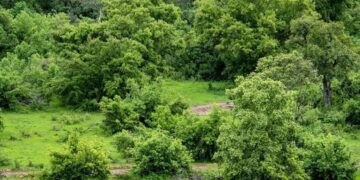
This morning unfolded in the slow, diligent rhythm that serious reading demands. I spent it in my garden, coffee in hand, devouring the Budget as one might study a map before a long journey — alert to its pathways, detours, and quiet confessions. There is a curious intimacy to reading public documents in private spaces: the leaves tremble while you weigh policy choices; birds argue in the background while you examine deficit trajectories and environmental taxonomies. It is in such settings that one sees policy not as an abstraction but as the architecture of the future we will have to inhabit.
The 2026 Budget, when read with patience rather than ceremony, reveals something fundamental: Ghana appears to be acknowledging that ecology and economy are now fused domains. This is not environmentalism as advocacy; it is environmental stewardship as statecraft. The document treats nature less as a background condition and more as an active variable in fiscal stability, infrastructure planning, and national risk management. This pivot is overdue — but it is also bold, because it forces us to evaluate the integrity of our institutions, the honesty of our data, and the seriousness of our governance culture.
A serious ambition, wrapped in technical architecture


The Budget’s environmental components are not ornamental. The expansion of the Ghana Green Finance Taxonomy is not merely definitional but directional: by specifying what counts as “green,” it silently decides what will receive financing, which industries will adjust, and how banks, developers, municipalities, and contractors will defend their claims. This is the beginning of a discipline — but it only works if compliance becomes the norm rather than the exception.
The introduction of sovereign drought insurance and a parametric flood-insurance scheme marks a rare moment where Ghana transitions from reactive budgeting to anticipatory governance. This is not just finance; it is ideology. It signals that climate shocks are no longer treated as anomalies but as structural features of our development environment. To insure is to admit vulnerability; to insure well is to prepare for continuity.
The proposed water-treatment complexes for Damongo, Tamale, Yendi, and the country’s sanitation expansions do more than supply services. They redefine what counts as “infrastructure.” In a climate-stressed century, water plants and urban sanitation are not social amenities — they are national resilience systems that anchor the health economy, reduce vector-borne disease costs, and lower the public-health burden that strains the budget every fiscal year.
Yet the most striking shift is in natural-resource governance. Declaring forests and water bodies high-security zones and merging surveillance with land-digitisation tools represents an overdue recognition that illegal mining and land encroachment are not rural irritations but organized ecological crime with macroeconomic consequences: silted hydropower dams, poisoned water treatment systems, disrupted food systems, inflated health bills, and the erosion of investor confidence.
Ghana is not simply protecting trees; it is protecting the fiscal future.
But ambition is only as sturdy as the institutions that carry it
We have seen this pattern before: ambitious environmental agendas that dissolve under the weight of weak institutions. The 2026 Budget will not escape this fate unless certain conditions — technical, legal, procedural — are established with uncompromising clarity.
1. Metrics, or the reform will fail.
Green taxonomies and climate projects require more than labels; they require verified numbers. Without machine-readable dashboards, penalty-linked timelines, and independent audits, even the best-intended interventions become performative. Environmental policy without measurement is a form of polite fiction.
2.*Insurance must remain immune to opacity and politics.
Parametric insurance works precisely because it removes discretion. The public must know the trigger thresholds, satellite data sources, monitoring periods, payout corridors, and dispute-resolution mechanisms. Otherwise, bureaucratic discretion will creep in, and the product will lose its credibility.
3. *The petroleum-domestic-investment shift must be constitutionally protected.*
Reallocating petroleum savings to domestic infrastructure is only transformative if protected against political appetites. Escrowed funds, third-party trustees, annual actuarial reviews, and quarterly public audits are not bureaucratic ornaments — they are the scaffolding that keeps good policy upright.
4. Enforcement must become technical, not theatrical
Satellite imagery, time-series drone mapping, hydrological sensors, and interoperable land registries must become routine tools. Ghana cannot continue fighting 21st-century environmental crime with 20th-century administrative tools. Nor can it ignore livelihood transitions; enforcement without alternatives is displacement, not policy.
5. *The circular economy requires industrial ecosystems, not pilot projects.*
Small grants and recycling pilots are seedlings; scaling requires procurement mandates, quality standards, stable feedstock agreements, and industrial clustering strategies. Without these, we will have innovation without industry — motion without economic mass.
6. *Independent science must not be optional.*
A permanent Scientific Advisory Unit will do more than validate carbon methodologies or audit biodiversity impacts. It will give Ghana credibility in global climate finance markets — the kind of credibility that attracts concessional capital, lowers borrowing costs, and positions the country as a regional environmental hub.
What lies beneath: a shift in the philosophy of governance
What moved me most this morning — beyond the technicalities — was the philosophical implication of this Budget: it treats nature as an asset class while reminding us that institutions are the custodians of that asset. In the garden’s quiet, it became obvious that this is less a budgetary exercise and more a governance test. It is about whether the state can discipline itself, whether ministries can cooperate, whether procurement can withstand scrutiny, whether data can function as public accountability rather than bureaucratic ornament.
The Budget presents tools — sophisticated ones. But tools only matter when they are used. And used well.
The task ahead*
The path forward is, paradoxically, both simple and demanding:
* *Make every major green investment publicly measurable* .
*Publish insurance triggers, thresholds and payouts in advance* .
*Subject petroleum-funded infrastructure to quarterly, independent, public audits.*
*Modernise enforcement with real-time data and community-grounded safeguards.*
*Institutionalise independent scientific review as a governance norm, not a courtesy** .
These steps sound procedural. They are not. They are what separate aspiration from achievement.
As I closed the Budget this morning, my coffee long finished, one thought lingered:Ghana has chosen a path that insists that our prosperity must be ecological, or it will be brief.
Turning that path into reality will require courage, institutional honesty, and relentless transparency. But if we succeed, the 2026 Budget will be remembered not as a document but as a pivot — the moment Ghana accepted that environmental stewardship is not a moral accessory but a central pillar of national strategy.
_Festina lente._