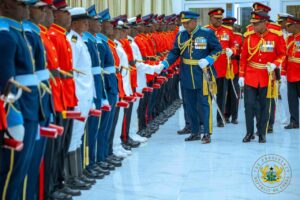
President John Dramani Mahama has reaffirmed his administration’s commitment to strengthening the Ghana Armed Forces, stressing that the induction of new officers reflects the country’s determination to maintain a resilient and capable military despite limited resources.
Speaking at the graduation parade for Regular Career Course 64 intake 256 and Short Service Commission and Special Duties Course 62 at the Ghana Military Academy on Friday, January 30, 2026, the President highlighted the increasingly complex security climate in West Africa. He warned that violent extremism, terrorism, and transnational crime continue to threaten stability, particularly along Ghana’s northern frontier.
According to President Mahama, safeguarding national security requires collective responsibility, urging citizens and institutions alike to adopt an “all-hands-on-deck” approach to preserve peace and stability.


He noted that commissioning officers under current economic constraints demonstrates the government’s resolve to equip the Armed Forces to meet emerging threats. The President also reiterated plans to retool the military through strategic investments, including the engagement of 48 engineers under the government’s “Big Push” initiative to boost the Armed Forces’ internally generated funds.
On the issue of illegal mining, President Mahama maintained a firm stance, vowing that the crackdown on galamsey will continue without fear or favour. He described the fight as a shared moral and civic duty, calling on Ghanaians to unite in protecting the country’s natural resources.
The President also acknowledged ongoing conflicts in areas such as Boko, Benigiri, and Nkwanta, which have disrupted lives and livelihoods, assuring affected officers that the government remains committed to their welfare and will work toward acceptable solutions.
He emphasized that improving the operational readiness of the Armed Forces remains a top priority, with investments focused on modern equipment, advanced training, and enhanced welfare packages to effectively address threats such as terrorism, piracy, and cross-border crime.