
By Ibanga Isine and Anas Aremeyaw Anas
Weaponization of law against our colleague journalists in Nigeria, Egypt, and India
There is a law that doesn’t proclaim its existence. It doesn’t storm newsrooms in the middle of the night, doesn’t come with boots on and doesn’t come shouting. It comes silently, inside an envelope bearing the stamp of a court. It mostly dresses in suit. It quotes statute. It calls itself “national security,” “cybercrime prevention,” “reputation protection.”
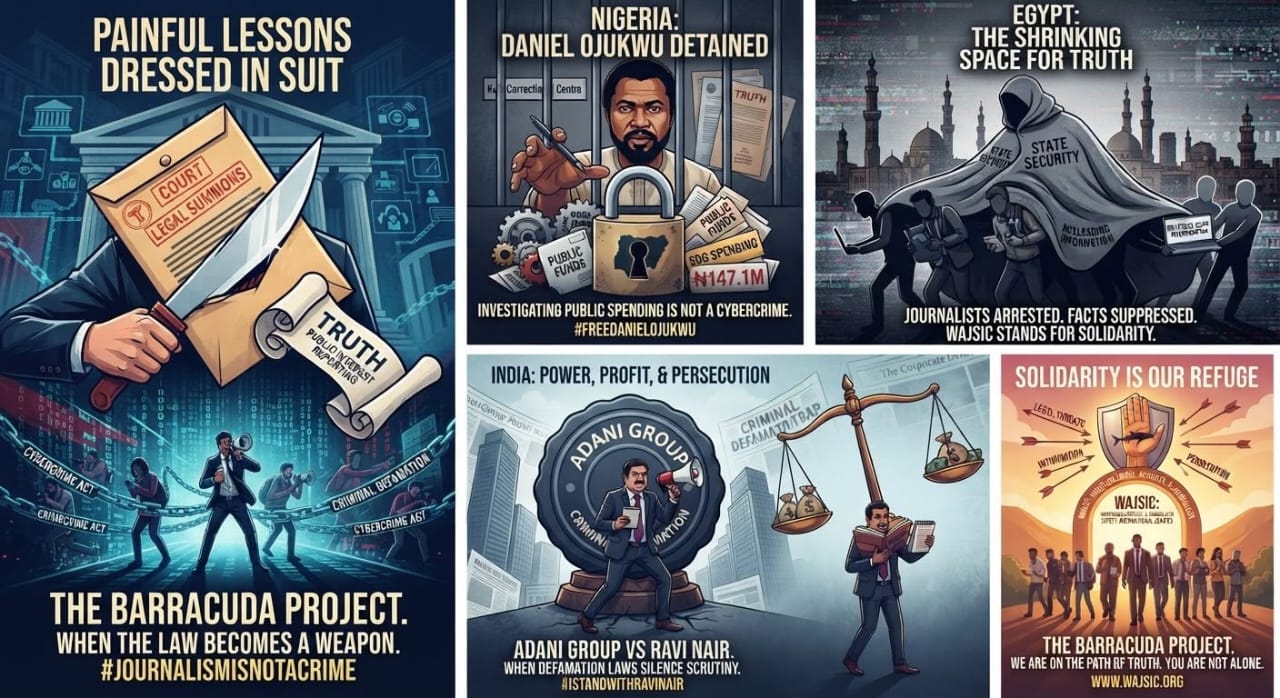
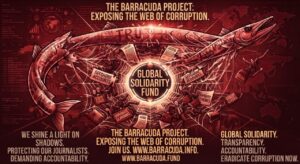
And then it eats the truth-teller alive. The Barracuda Project – that relentless, cross-border crusade for accountability has learned the hardest lesson: the deadliest trap is not the one laid by dictators who ban the press completely. It is the one laid by institutions meant to shield the media, but now turned like a knife on journalists. Before we delve into the ordeals of our colleagues on this project (Barracuda) from Egypt and India, let us first introduce the person closest to home, Daniel Ojuku. On November 10, 2026, Ojukwu, a journalist with the Foundation for Investigative Journalism, was placed under remand at Kuje Correctional Centre, Abuja, after entering a not guilty plea to 12 charges of alleged criminal defamation and cyberstalking.
The accusations are related to reports that look at the Office of the Senior Special Assistant to the President’s Sustainable Development Goals spending. An alleged payment of approximately
₦147.1 million to a restaurant for the building of classrooms and a skills acquisition centre was the subject of one of the investigations. The public-interest question is simple: were the promised facilities delivered and were public funds used appropriately?
The journalist now faces the possibility of protracted criminal proceedings instead of allowing the allegations to be investigated through open public records, evidence, and a suitable legal response.
Particularly concerning is his remand pending a bail hearing on December 1. Because his
reporting is controversial, a person who has entered a not guilty plea shouldn’t be subjected to
completely unnecessary prison time.
In order to combat crimes like identity theft, online fraud, and other types of digital criminality,
Nigeria passed the Cybercrime Act. However, press freedom organisations have consistently
criticised its application to journalists, especially when accusations of cyberstalking and
defamation stem directly from reporting on public officials and politically exposed persons. The
risk is clear: the law becomes a handy tool for press intimidation if every uncomfortable
investigation can be reframed as a cybercrime. Nigeria moved from 122nd to 112th in the 2026 RSF’s Press Freedom Index, but this does not mean that journalists are safe in the country. For media professionals, the country continues to be among the riskiest and most challenging places in West Africa. It was ranked 149th in the world for security. The detention of Ojukwu only serves as an example of why urgent reform and accountability are still necessary even with an improved overall press freedom ranking.
Another sign of the shrinking space for independent journalism under President Abdel Fattah el-
Sisi in Egypt is the arrest of six journalists who worked for the independent investigative and fact- checking platform Matsadaash. On September 28 and 29, 2026, authorities took the journalists into custody. Amnesty International later stated that they were tortured and coerced into making self-incriminating statements, while human rights organisations noted that they were first detained incommunicado.
Egyptian authorities charged the platform with disseminating misleading information
and attempting to destabilise the country. The journalists are still entangled in a legal battle over
accusations of publishing false information and committing crimes connected to terrorism.
Mohamed Adel, who had spent months investigating Deutsche Bank documents for an
international investigative project, is among those detained. After his arrest, colleagues finished
and published his work. It is hard to overlook the irony: a journalist looking into financial
transactions and informing the public about issues of global significance was denied his freedom while the investigation went on without him.
According to Reporters Without Borders’ (RSF) 2026 World Press Freedom Index, Egypt ranks
169th out of 180 countries, indicating a press environment where independent scrutiny is
increasingly viewed as a threat. The line between legitimate national security enforcement and the repression of dissent is dangerously blurred when journalists are accused of terrorism or
destabilisation for doing work that should be recognised as public-interest reporting.
In India, the case of investigative journalist Ravi Nair clearly shows that the weaponisation of
legal processes is not limited to Africa or governments that openly declare themselves
authoritarian. In February 2026, Nair received a one-year prison sentence in a criminal defamation case brought by the Adani Group, one of India’s most powerful corporate conglomerates. The case arose from social media posts criticising the group’s business practices. Nair’s lawyers argued that his comments were based on publicly available information and constituted fair criticism; the court however, found the posts defamatory. The case raises an important question about the power dynamic between a journalist and a large corporation with the resources to engage in prolonged litigation.
Journalists may be discouraged by criminal defamation laws that allow for incarceration,
especially if they are looking into influential corporate interests and their connections to political
power. The idea that businesses shouldn’t be allowed to safeguard their reputations is not the issue.
It is that legitimate scrutiny should not be discouraged by the threat of imprisonment. India dropped from 151st in 2025 to 157th in the RSF World Press Freedom Index for 2026.
Concerns raised by RSF include increased overt political alignment among media outlets,
concentrated media ownership, and violence against journalists. Therefore, Nair’s case needs to be considered in the context of a larger discussion concerning press independence and the freedom of journalists to examine influential political and corporate figures without fear of criminal prosecution.
Despite the differences between these three cases, they all show an unsettling pattern. An
investigative newsroom in Egypt has been accused of “fake news” and national security. Due to
investigations into public spending, a reporter in Nigeria has been imprisoned on charges of
cybercrime and criminal defamation. A journalist who criticises a powerful corporation in India
has been sentenced to prison for criminal defamation.
The broader global context is equally disconcerting. At the end of 2025, CPJ reported that 330
journalists were imprisoned globally due to their work, the third-highest number since it started
keeping records in 1992. According to RSF’s 2026 index, 110 of the 180 countries evaluated saw a decline in the legal environment for journalism. More than half of the countries and territories
surveyed had a difficult or very serious press freedom scenario.
The implications for Africa are extremely troublesome. The continent cannot credibly claim to be
strengthening democratic institutions while journalists investigating public spending, corruption,
abuse of office, and human rights violations face intimidation, arbitrary detention, and criminal
charges. Governments must understand that public officials are not immune to scrutiny, and
neither national security nor reputational protection should be used as a blanket excuse to suppress uncomfortable questions.
The African Union, regional institutions, and national judiciaries must adopt a more assertive
stance. Laws that criminalise legitimate journalism should be reviewed. Public officials who
believe they have been misrepresented should respond with evidence, corrections, and lawful
remedies proportional to the alleged harm, rather than using the state’s machinery to punish
journalists.
Investigative journalism is not an act of hostility toward the government. It is an essential public
service. It provides citizens with the necessary information to hold those in power accountable. A government that disagrees with a report has the right to question its accuracy. It does not have the authority to imprison the reporter solely because the findings are embarrassing.
When journalists are silenced, it is not just the media that suffers. Citizens lose access to the truth, public resources become more difficult to track down, corruption becomes easier to hide, and those in positions of power face fewer consequences.
The true test of a democracy is not how easily it accepts praise, but how fair it treats those who
expose its weaknesses. There is a palpable sense of unease about what lies ahead for many of us following the Barracuda Project. We have no idea what the consequences will be, who will be put under pressure, or what doors will close unexpectedly as a result of our decision to seek the truth.
But one thing is certain: even if we are victimised through legal battles, intimidation, or
persecution, we will remain free in the most important sense of the word — because we are on the path of truth. There is no greater freedom than knowing you stood up for what was right when it mattered.
In case you face persecution as a result of your involvement with Inside Deutsche Bank, and other investigative reporting projects, our organisation, Whistleblowers, Activists and Journalists Safety International Centre (WAJSIC) will come with open arms. It will welcome you to its sanctuary.
WAJSIC exists so that we always have a door to knock on when other doors are slammed shut; a
home to stay in when the world becomes hostile; and a place of refuge when adversity beats a
whistleblower, journalist, or activist sore.
Let journalists be journalists. Allow whistleblowers to speak. Allow activists to stand their ground.
Let those who seek the truth know that they do not have to travel the difficult road alone. Because when the truth becomes dangerous, solidarity is our refuge.