
By Richard DABLAH
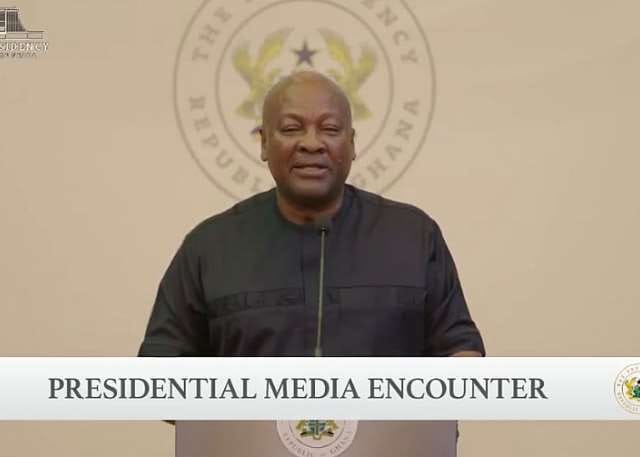
The public’s rage at the sight of rivers turned to mud and forests scarred is legitimate. Rage is also a poor architect. When a president refuses to be hurried into exceptional measures, that refusal is not always timidity; sometimes it is the last, rational defence of the rule of law. President John Dramani Mahama’s decision to withhold an immediate state of emergency in the fight against illegal mining is a strategic choice that recognises the problem’s complexity and the dangers of short-term power grabs. The crisis of galamsey is not a single battlefield; it is a fractured ecosystem — legal, financial, social, and ecological — that will be destroyed still further if the remedy is blunt, unchecked force.
The diagnosis: galamsey is a complex adaptive system. It is sustained by demand for gold, porous regulation, local poverty, political protection, transnational laundering and a shadow logistics network that moves ore, cash and influence across borders. The visible image — men and machines at riverbanks — is a node, not the whole network. Satellite and on-the-ground studies show the scale: mercury and heavy metals have contaminated a majority of water sources in affected areas and vast tracts of forest and cropland have been lost, creating structural damage to ecosystems and livelihoods that will take generations to repair. Policy must therefore be proportional to that complexity: surgical, coordinated, and durable rather than theatrical and temporary.
A state of emergency is not simply an operational multiplier for police and soldiers; it is a legal and political regime change. Constitutional democracies treat emergency powers as exceptional because those powers concentrate discretion, shorten procedural safeguards and widen the space for discretionary seizures of property and liberty. Comparative constitutional scholarship warns that exceptions have a strong tendency to ossify: temporary powers become routine, oversight atrophies, and accountability evaporates. In practice, states that rush to exceptional measures frequently produce rights violations and institutional capture, undermining the long-term legitimacy needed to enforce environmental law. The risk is not hypothetical: scholarly reviews and comparative analyses trace how emergency regimes — even those introduced for seemingly urgent public goods — can be repurposed by political actors and security bureaucracies for other aims.


There is also a technical truth: boots on banks do not cut supply chains. Soldiers can burn dredgers and disperse camps. They cannot, by themselves, close the markets that buy illicit gold, freeze the laundered proceeds, or dismantle the corporate and trade networks that convert small-scale pits into macro-scale extraction. Asset flows, corporate registration systems, port documentation and banking channels are the real arteries of the illicit trade. International cooperation under the UN Convention Against Corruption and robust mutual legal assistance are essential complements to domestic enforcement; without them, seizures at the dig site are performative.
This is not an argument for paralysis. It is an argument for sequencing and for matching means to ends. There are four failure modes that a hasty emergency will accelerate:
Legal erosion. Accelerated arrests without evidence build fragile cases that collapse in court and entrench impunity for sponsors.
Capture of enforcement. Concentrated discretion without transparency invites patronage or opportunistic enrichment.
Rebound and violence. Short-term suppression without economic alternatives risks violent reoccupation and radicalisation of dispossessed communities.
Signal failure. When seizures are not followed by prosecutions and asset recovery, the public learns to distrust any future claim of “we recovered the loot.”
By contrast, a calibrated alternative can impose real cost on the system that sustains galamsey and produce wins that survive legal and political scrutiny.
Ghana already has new instruments and pragmatic options that, if implemented at scale and with technical rigor, will be more effective than a headline-driven emergency.
Operationalise GoldBod and the national task force as accountable legal instruments. The task force must be given a permanent, ring-fenced investigative budget, prosecutorial liaisons embedded from day one, and mandatory body-camera and GPS accountability for every operation. These measures reduce opacity and make evidence admissible in court. The task force model, if insulated from partisan appointments, can concentrate capacity without concentrating unchecked power.
Attack rents, not only pits. Use customs data, export records and buyer registries to choke demand. Mandate traceability for all gold flows, enforce licensing for buyers and processors, and sanction firms that purchase unverified gold. Make unlicensed market access the commercial risk, not the artisanal miner. This is economic triage: remove the margin that makes illicit mining profitable.
Build prosecutorial-first cases. Create joint investigative teams that pair EOCO, the Office of the Special Prosecutor, and forensic accountants. Prioritise cases that trace financial beneficiaries, not only foot soldiers. Freeze accounts through mutual legal assistance where funds leave Ghana. Work fast on bank records, shipping manifests and corporate ownership lines that can lead to high-value convictions abroad and at home. The goal is asset recovery and deterrence, not merely scenes for cameras.
Deploy measured enforcement with rights safeguards. When raids are necessary, they must be preceded by evidence-gathering, judicial sign-off where possible, and simultaneous measures to protect civilians. That reduces collateral harm and preserves court cases.
Offer credible exit pathways. Formalisation schemes must be real: licensing windows, technical training, crop-replanting grants, and conditional restoration payments tied to verifiable land rehabilitation. Supply-side suppression without viable alternatives is a recipe for relapse.
Recover value for remediation. Establish a remediation fund capitalised by forfeiture proceeds and export fees. Make restoration a visible public good that ties enforcement to repair.
Transparent metrics and oversight. Publish a public ledger of operations: arrests, prosecutions, asset freezes, and hectares rehabilitated. Independent auditors and a civil-society oversight board with enforceable reporting rights will make it harder for authorities to convert seizures into patronage.
Engage regional partners. Illegal gold is a transnational business. Work with neighbouring states and international agencies to block ports of convenience and to harmonise traceability standards.
This package is more politically demanding than a single emergency decree precisely because it exposes networks — and networks defend themselves. But strategic difficulty is not an argument for theatrical ease. The objective must be lasting deterrence: dismantle the market logic that rewards illegal extraction, secure convictions that survive appeal, and repair the natural capital. Those are public goods that a temporary military sweep cannot secure.
The choice before the president is stark but not perverse: choose a show that might look decisive and leave courts and communities worse off, or choose a disciplined program that risks short-term political pain but can actually dismantle the business model of illegal mining. The wiser course is to absorb the immediate anger, convert it into institutional capacity, and produce convictions, asset recovery, and restored rivers that citizens can point to decades hence.
History will be merciless to those who preferred spectacle over structure. Ghana needs enforcement that endures scrutiny, not an emergency that survives a trending hashtag. President Mahama’s restraint, properly channelled into the technical, legal and financial commitments above, can do more than save face; it can change a system.
Audi alteram partem