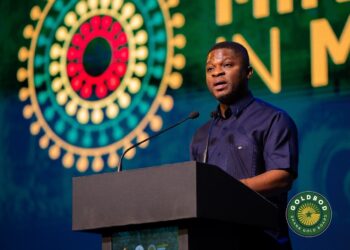
The Minister for National Security, Kan Dapaah, has disclosed that democracy in the West Africa sub region is under siege.
He said at a seminar organised by the Ministry of Information last 19 October, this year, that both foreign and local actors are employing Disinformation and misinformation to destabilize democracies across Africa.
According to the Minister, so dangerous is Disinformation and misinformation that it could influence voters to choose bad leaders in elections.
Read below the full unedited statement from the National Security Minister:

statement by the minister for national security on the impact of disinformation on electoral integrity, peace and stability in africA
SEMINAR ORGANISED BY THE MINISTRY OF INFORMATION AND THE INTERNATIONAL INSTITUTE FOR DEMOCRACY AND ELECTORAL ASSISTANCE
19TH OCTOBER, 2023
Honourable Ministers of State present,
Esteemed Invited guests,
Fellow citizens,
Ladies and Gentlemen,
- Permit me, at the very outset, to express my appreciation to the Ministry of Information and other esteemed stakeholders for the invitation to participate in this crucial seminar. It is, indeed, an honour to stand before you today to address an issue of paramount importance – the impact of disinformation on electoral integrity, peace, and security in Africa.
- This topic is profoundly relevant, sitting at the crossroads of the ongoing revolution in information technology fuelled by the internet, social media, and most recently, artificial intelligence, and the challenges faced by liberal democracy in our world today. West Africa, unfortunately, is witnessing a distressing trend of democratic reversals and the emergence of military rule, underpinned, to some extent, by disinformation and misinformation.
- Disinformation and its sibling, misinformation, have emerged as potent tools in recent times, utilised for influence operations and malicious campaigns that undermine electoral integrity, peace, and security. These campaigns are orchestrated by a spectrum of actors, including both state and non-state entities, local and foreign actors as well as political and non-political players.
- Even the most mature democracies are not immune, as witnessed in the unsettling events of January 6, 2021, when supporters of former President Trump stormed the Capitol Hill in the United States. This incident underscores the alarming impact disinformation can have on electoral processes and a nation’s stability.
- To reiterate, in West Africa, democracy is under siege, and disinformation is a formidable weapon employed by foreign and local actors to destabilize nations. Perpetrators ingeniously wrap their narratives around the genuine challenges faced by emerging democracies, such as poor governance, corruption, poverty, and unemployment, amplifying these issues to erode faith in democratic governance.
- The recent spates of coup in Burkina Faso, Mali and Niger provide a better context for analysing the role of disinformation and misinformation in undermining democracy, peace and stability in West Africa. The coup makers attempt to gain credibility for their actions through disinformation campaigns anchored on dissemination of false narratives, amplification of existing grievances and in some cases, promotion of extremist ideologies that ultimately create a polarised environment and a destabilised political climate.
- In the unfolding coups of West Africa, the periods before and after the insurrections are often inundated with disinformation and misinformation campaigns. Observations highlight that during these critical junctures, certain external geopolitical players with stakes in Africa strategically employ misinformation to instigate discord and cultivate a climate of dissatisfaction, ultimately fostering a conducive environment for political upheaval.
- An unfortunate aspect of the emerging disinformation and misinformation crisis in West Africa is the involvement of the youth who, out of the need to meet their economic and financial needs, get recruited by both local and foreign collaborators to create ‘troll farms’ on social media aimed at misinforming and disinforming the public.
- In our own nation, Ghana, a more disconcerting trend is emerging, notably following the coup in Niger. Certain individuals in academia, civil society, and the media have been propagating false narratives in support of a coup or military rule. These actors have gained substantial followings on social media, leveraging their influence to disseminate misinformation that threatens our nation’s peace and stability, especially as we approach the critical December 2024 general elections.
- Misinformation, whether intentional or inadvertent, from these influential individuals, poses a significant threat to Ghana’s stability. Baseless political commentary undermines public confidence in vital institutions like the Electoral Commission and the Judiciary, potentially steering our country towards a perilous path.
- Beyond the erosion of public trust in the institutions of state which culminates in public cynicism and scepticism, disinformation and misinformation create a misinformed public whose decisions on policies and elections are influenced by false narratives; a development that ultimately undermines democratic processes. To put it in a better perspective, misinformation and disinformation can influence voters to make decisions which are inconsistent with their best interests and this could include the election of a bad leader and opting for a bad public policy; all of which can have catastrophic consequences for the survival of a State.
- It also needs highlighting that disinformation and misinformation on social media are inciting the youth in Africa to engage in vitriolic commentary and insults toward political authorities, religious leaders, and traditional figures. This alarming trend contradicts our cherished African culture of respect and veneration for authority, jeopardizing the moral fabric of our society and weakening our democracy.
- While democracy upholds the right to free speech, it is crucial to differentiate between free speech and the propagation of disinformation or insults. The right to free speech as enshrined in the 1992 Constitution of Ghana should not be equated to the right to disinform or misinform. As we approach a critical election year, all citizens must recognize their collective responsibility in combating misinformation, an imperative for safeguarding our cherished democracy.
- The media and civil society, esteemed pillars of democracy, must exercise their roles responsibly, refraining from becoming conduits for disinformation and misinformation. Government, too, must redouble efforts to ensure unhindered access to accurate information, building upon the strides made, such as the passage of the Right to Information Act.
- More importantly, we must, as a people, embrace and incorporate fact-checking into both private and public discourses as a way of dealing with the menace of misinformation and disinformation. By infusing fact-checking into our discourses, we create a more informed public and a robust democratic system which are impervious to false narratives.
- In conclusion, I reiterate the urgent need for collaborative efforts to eradicate disinformation and misinformation from our body politic. Let us exercise our right to free speech responsibly, offering constructive criticism that bolsters democratic governance and instils public confidence in our state institutions. This path alone guarantees the safety of our democracy and fosters development within the realms of freedom.
- Thank you