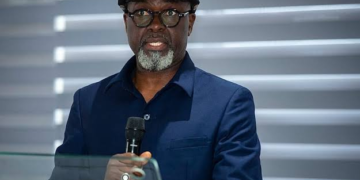
The credibility of broadcaster Paul Adom-Okyere is under intense national scrutiny after his conspicuous silence on a unanimous 5–0 Supreme Court ruling in favour of investigative journalist Anas Aremeyaw Anas, a ruling that directly overturns earlier judgments Adom-Otchere had celebrated on his television programme.
“For years, Adom-Otchere used his Good Evening Ghana platform to dissect the Court of Appeal decision that dismissed Anas’ case against Adolf Tetteh. He delivered a dramatic, forensic-style breakdown that painted the ruling as a national reckoning. He spoke with urgency. With conviction. With the authority of a man determined to “set the record straight.”

But when the Supreme Court the highest judicial body in the country overturned that same judgment, correcting the legal narrative from top to bottom, Adom-Okyere fell completely silent.
Not a sentence.
Not a headline.
Not a segment on the show where he once declared the case a matter of public justice.” Professor Winston said in his write up to Paul Adom Otchere
That silence is now the story.
“This Is Not Journalism — It Is Narrative Manipulation”
-Kwaku Sekyi, Media Ethicist
Media ethicist Kwaku Sekyi did not mince words in his analysis of Adom-Otchere’s conduct.
“You cannot scream a Court of Appeal ruling into national importance and then pretend the Supreme Court has not spoken. That is not journalism — it is narrative manipulation.”
Sekyi went further, describing the broadcaster’s selective approach as a threat to public trust.
“When a journalist chooses which truths to amplify and which to bury, he stops informing the public and starts deceiving them.”
Professor Winston’s Explosive Letter: “You Used Your Platform to Spread Fabrications”
Adding to the backlash is a blistering letter from Professor Alfred Winston, accuses Adom-Okyere of deliberately using his platform to smear Anas.
Winston states plainly:
“Anas has been the subject of unwarranted attacks from you, many based on misinformation and fabrications.”
He directly accuses the broadcaster of aligning himself with Kennedy Agyapong’s unsubstantiated claims, saying the TV host portrayed Anas as a “land thief” on national television.
And then comes the blow:
“Today, I bring to your attention a 5–0 Supreme Court ruling in his favour, I am requesting that you use your platform to present the current factual position, just as you did last year, but if you don’t, I would not be surprised.”
He reminds Paul Adom-Otchere that the earlier portrayal damaged Anas’ reputation:
“Those familiar with him, including you Paul know very well he is neither corrupt nor a thief. His involvement in these attacks stems solely from his commitment to combating corruption.”
In what many observers describe as a direct challenge to Adom-Okyere’s integrity, the professor concludes:
“Consider my request an appeal for fairness in accordance with natural justice.”
Critics Say the Silence Is Intentional — Not an Oversight
Media analysts, journalists, and members of the public say the broadcaster’s silence cannot be explained as forgetfulness. The case was too big. The earlier editorial too forceful. The reversal too significant.
The consensus among critics is simple and brutal:
Paul Adom-Otchere speaks when the story pleases him and disappears when the facts disagree.
Some analysts describe it as a “pattern,” pointing to previous instances where the broadcaster has aggressively pursued narratives that favour certain political interests while ignoring contradictory evidence.
“This Is a Test of Integrity — and He Has Failed It”
Prominent media watcher Kwaku Sekyi summarized public sentiment starkly:
“A journalist’s integrity is tested not when the story favours him, but when it contradicts him. In this test, Paul has failed.”
A Defining Moment for Media Accountability
The Supreme Court’s decision reshapes the entire legal narrative around the land dispute. It restores the reputations of individuals whose names were dragged through public mud including by Adom-Otchere himself.
Yet the broadcaster’s refusal to revisit the matter has triggered a larger debate about power, influence, and responsibility in the media.
Observers warn that if broadcasters can selectively report national truths, Ghana’s democratic information space becomes vulnerable to manipulation.
Stay tuned