
By Richard DABLA
(richard.dablah@gmail.com)
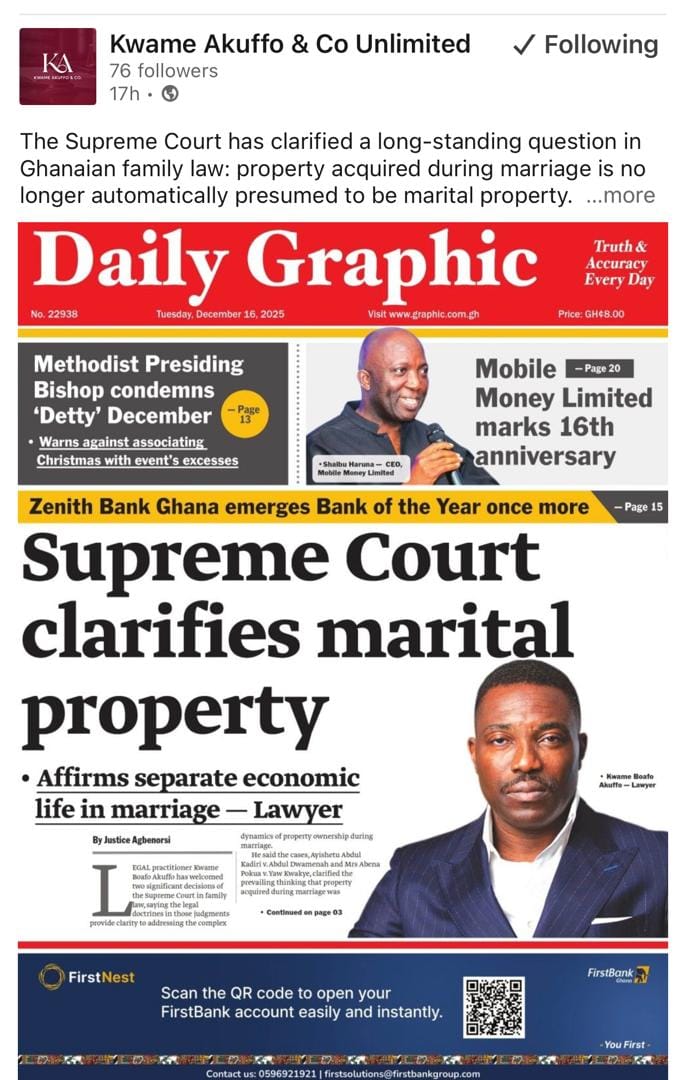
The Supreme Court says property acquired during marriage is not automatically marital property. This is not a legal sentence. It is a psychological x-ray. It reveals how much fear now structures intimacy in Ghana.
Marriage used to be a conspiracy against uncertainty. Two people joined not because the future was predictable, but precisely because it was not. The presumption of shared property was a wager on permanence. It said: _we do not know what will happen, so we will face it together_ . The law has now updated the wager. It says: _we no longer trust togetherness to survive the future._


What changed is not doctrine. What changed is the economy of trust.
In today’s Ghana, love arrives already carrying receipts. Romance is audited. Courtship is a due-diligence exercise disguised as destiny. Before affection is allowed to settle, assets are quietly mapped: who owns land, who rents, who has a passport, who has siblings that never stop calling, who sends money home every month, who will become a burden first. People do not say these things aloud, but they count them. The counting begins early.
This is not cynicism. It is intelligence shaped by scarcity.
Marriage has become the most sophisticated informal financial instrument in the country. It hedges against unemployment, sickness, inflation, family emergencies, and social failure. When the state withdrew from long-term care, marriage absorbed the shock. When wages flattened, marriage redistributed income privately. When pensions became unreliable, spouses became retirement plans. No institution was designed for this weight, yet marriage carried it anyway.
Now it is cracking.
The Supreme Court did not cause the crack. It merely confirmed that the structure had already been stressed beyond its moral yield strength. Separate economic life is not a recommendation; it is an admission that the old fiction of automatic sharing can no longer survive the realities of modern accumulation.
But something darker hides underneath this clarity.
In Ghana today, marriage is increasingly a site of *asymmetric extraction* . One partner’s productivity is visible and priced. The other’s is ambient and unpaid. The market recognises income, not endurance. It records cash flows, not years lost to care, not emotional labour, not the slow erosion of personal ambition so another person’s life can scale. This asymmetry has always existed, but it used to be socially buffered by the presumption of shared outcome. Remove the presumption and the imbalance becomes naked.
The law speaks of contribution. The economy defines contribution narrowly. Between those two definitions lies a quiet violence.
And yet, to deny separate economic life is also dishonest. Because exploitation does not only move in one direction. There are marriages in which affection is weaponised, dependency cultivated, sacrifice strategically exaggerated, and love converted into lifelong entitlement. The Court knows this. Society knows this. Everyone knows someone whose marriage was not partnership but parasitism. The law is responding to these ghosts too.
This is why the ruling feels unsettling. It flatters no one. It accuses everyone.
It accuses men who hid assets while preaching unity.
It accuses women who were encouraged to trust without protection.
It accuses churches that sanctified imbalance.
It accuses families that demanded loyalty without reciprocity.
It accuses the state for outsourcing welfare to intimacy.
What we are witnessing is not legal progress or moral decay. It is the *end of innocence* . Marriage can no longer pretend to be outside economics. It must now account for itself like everything else in Ghana: transparently, defensively, intelligently.
But intelligence has a cost.
When spouses begin to live as parallel economies under one roof, something subtle dies. Not love — love is resilient — but generosity without calculation. The instinct to give without future litigation in mind. The courage to be temporarily weaker without fearing permanent loss. When people love with one eye on the exit, intimacy becomes efficient but thin.
We are becoming very good at surviving each other.
The irony is this: the same society that fears being economically exploited in marriage tolerates systemic exploitation everywhere else. We accept unpaid internships, casualised labour, delayed salaries, predatory loans, land insecurity. But inside marriage, we demand perfect accounting. We are ruthless with our intimates and forgiving with institutions.
Perhaps because institutions never promised to love us.
So what now?
The answer is not to romanticise the past or fetishise legal autonomy. It is to ask a harder question: *what kind of people does our economy require us to become in order to survive?* Suspicious? Strategic? Self-contained? Always hedged?
If that is the citizen the economy needs, then marriage will mirror it faithfully.
The Supreme Court has drawn a line. But the real judgment is not legal; it is civilisational. We must decide whether marriage will become merely a contract between cautious individuals, or whether we will rebuild the social infrastructure — wages, housing, healthcare, pensions — that once allowed people to risk generosity.
Because love does not fail first.
Security does.
And when security collapses, even the most sacred bonds start demanding collateral.
_Lex loquitur. Societas respondet._