
By Richard Dablah
A country cannot call itself prosperous while allowing the natural foundations of its future prosperity to disappear. Ghana’s illegal gold-mining crisis exposes the economic, institutional, and moral costs of a model of development that rewards extraction but inadequately accounts for preservation.
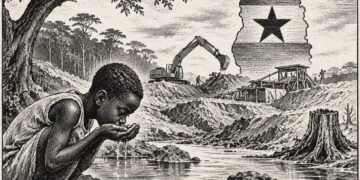
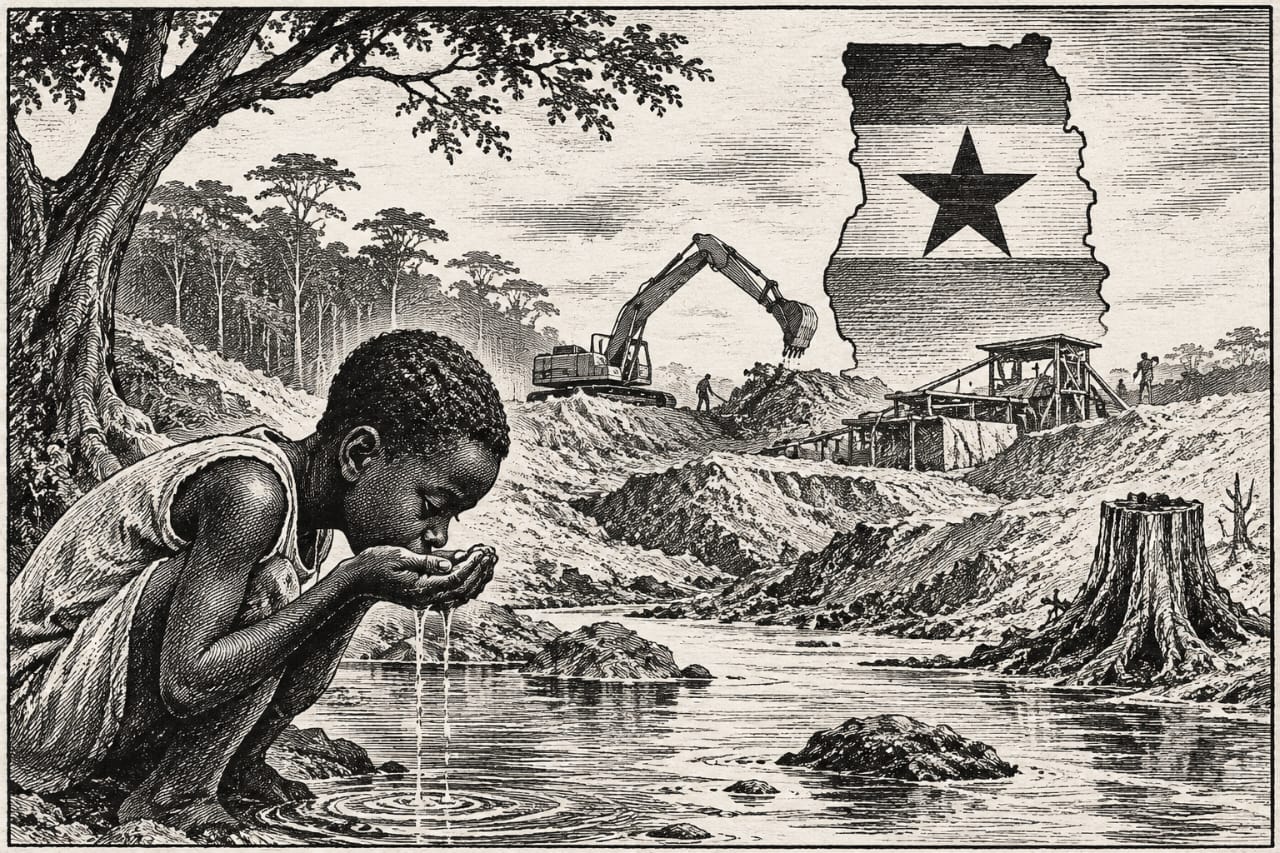
On 10 November 2026, Ghana’s Environmental Protection Authority had to warn residents in communities affected by illegal mining that boiling polluted river water would not necessarily make it safe to drink. Water contaminated with substances such as mercury, cyanide, and arsenic cannot be made safe simply by applying heat. Some rural communities, lacking reliable access to piped water, continue to depend on streams and rivers exposed to mining pollution.
There is something profoundly revealing about this situation. A country endowed with gold, fertile land and considerable natural wealth is confronting circumstances in which communities cannot safely rely on some of the water sources that sustain their everyday lives. The paradox is not merely environmental. It concerns the very meaning of economic development.

Ghana’s galamsey crisis, the term commonly used for illegal small-scale gold mining, invites a difficult question: can a country become wealthier through the extraction of its natural resources while progressively destroying the productive foundations of its future?
The answer depends, in part, on what a country chooses to count as wealth.
The accounting error at the heart of extraction
Gold is visible in national economic calculations. It can be mined, sold, exported, and converted into revenue. Its production supports commercial activity and provides livelihoods. Yet the depletion of the ecosystems that sustain agriculture, freshwater supplies and local economies is much less visible in conventional assessments of economic performance.
This is an important accounting problem. When the value of extracted minerals is recorded as economic activity, but the depletion of natural capital is inadequately reflected, a country risks confusing the conversion of assets into income with the creation of lasting wealth.
The distinction matters.
A mining operation may generate immediate financial returns while transferring its environmental costs to downstream communities, farmers, taxpayers and future generations. The person who captures the commercial benefit is not necessarily the person who pays for the contaminated water, degraded land or expensive rehabilitation.
In economic terms, this is a problem of externalised costs. In moral terms, it is a question of justice.
Ghana must therefore move beyond measuring the mineral economy principally through production, exports and revenue. It must also account for the ecological assets being depleted, the public expenditure required to respond to the damage and the productive opportunities that may disappear as a consequence.
A country can report rising mineral activity while experiencing a decline in the underlying natural wealth on which its wider economy depends.
The river is part of the economy.
It is tempting to regard water pollution as a problem belonging principally to environmental regulators. That interpretation is too narrow.
Rivers connect agricultural production, food security, household welfare, public health, industry and the livelihoods of entire communities. Their degradation can affect several sectors simultaneously. It can increase the cost of providing safe water, compromise agricultural possibilities and weaken the resilience of local economies.
The river, therefore, is not simply an environmental resource. It is part of the country’s productive infrastructure.
Unlike a road or factory, however, an ecosystem cannot always be restored within a normal investment cycle. Some forms of damage may persist for decades, while others may be difficult or prohibitively expensive to reverse. The destruction of an ecological system can thus impose economic liabilities that outlive the political administration and the commercial actors responsible for the initial extraction.
This is why the galamsey debate must incorporate the concept of intergenerational responsibility. The natural environment is not an unlimited stock of materials available for one generation to consume. It is an inheritance that must be maintained if subsequent generations are to enjoy comparable opportunities for health, security and prosperity.
The state must understand the economy behind the mining site
The persistence of illegal extraction cannot be understood solely by examining the people operating machinery at mining sites.
Every organised extractive activity depends on economic relationships: finance, equipment, fuel, labour, transportation, mineral purchasing and the movement of money. The mining site is the visible end of a much wider commercial chain.
A response concentrated exclusively on raids, arrests and equipment seizures risks addressing the most visible participants without adequately investigating the financial and commercial arrangements that make extraction possible.
Ghana needs an enforcement model capable of following the money and the mineral. That means investigating financing networks, beneficial ownership, equipment supply, gold purchasing arrangements and the traceability of commercially traded minerals.
This must be done within the law, with due process and evidence-based investigations. Nor should every person involved in artisanal mining be treated as though they occupy the same position. Organised financiers, illegal operators, vulnerable workers and legitimate small-scale miners have different responsibilities and circumstances.
The objective should be to make unlawful extraction commercially unsustainable while creating credible opportunities for responsible mining.
The state must also confront a deeper institutional question: how can several public bodies possess legal authority over an activity while the combined exercise of that authority remains insufficient to prevent widespread harm? The answer lies not only in enforcement but in coordination, information, accountability and the capacity to sustain decisions over time.
Development cannot be separated from preservation
The galamsey crisis exposes a weakness in conventional approaches to development. Countries are frequently judged by how successfully they attract investment, expand exports, increase production and create employment. These are legitimate objectives, but they are incomplete when the condition of the natural assets underpinning economic activity is excluded from the assessment.
Development should not mean converting natural wealth into immediate financial returns at whatever cost. It should mean transforming natural resources into enduring productive capabilities.
That requires a more demanding national compact.
Mining permits must carry enforceable environmental obligations. Restoration should be supported by credible financial guarantees established before damage occurs. Independent monitoring should measure whether rivers, forests and degraded lands are recovering. The ownership and origins of commercially traded gold should be more transparent.
Communities must also be treated as participants in resource governance rather than merely as recipients of environmental consequences. Their access to clean water, land, livelihoods and meaningful consultation must form part of the institutional framework.
At the same time, Ghana must recognise that enforcement alone cannot resolve the economic dependence of some communities on small-scale mining. Formalising lawful artisanal operations, improving technical standards, supporting agricultural enterprises and creating employment in land rehabilitation are necessary elements of a durable transition.
An environmental policy that ignores livelihoods risks becoming socially fragile. But an employment strategy that destroys the natural systems upon which communities depend is economically self-defeating.
Responsibility does not end at Ghana’s borders
There is also an international dimension to this crisis. Gold extracted in Ghana enters markets that extend far beyond the communities where mining takes place. The commercial benefits may be distributed across several countries, while the environmental consequences remain concentrated in the producing regions.
International buyers, traders and refiners therefore have a responsibility to examine the origins of the gold they purchase. Traceability and due diligence should be meaningful requirements of responsible mineral commerce, not merely voluntary expressions of corporate concern.
Producing countries must strengthen their own institutions, but global demand cannot be disconnected from the conditions under which commodities are extracted.
The responsibility for protecting the environment cannot rest exclusively with the communities that suffer its degradation or the governments within whose territory the extraction takes place.
The measure of prosperity
Ghana’s challenge is ultimately larger than the fight against illegal mining. It concerns the kind of economy and society the country wishes to construct.
The real test of public leadership should not be confined to the quantity of gold extracted, the volume of exports or the number of enforcement operations conducted. It should include whether communities have safe water, whether damaged ecosystems are being restored, whether mining produces lasting public value and whether institutions can preserve these gains beyond an electoral cycle.
There is a fundamental difference between extracting wealth and building prosperity. The former can happen rapidly, sometimes at considerable social cost. The latter requires institutions, patience, accountability and a recognition that economic freedom carries obligations towards others.
Ghana does not need to abandon its mineral wealth. It needs to govern that wealth with a much clearer understanding of its social and ecological consequences.
The rivers are not obstacles to development. They are among the conditions that make development possible.
A generation’s achievement should not be measured only by the wealth it extracts from the earth, but by the productive and natural inheritance it leaves to those who come after it.