
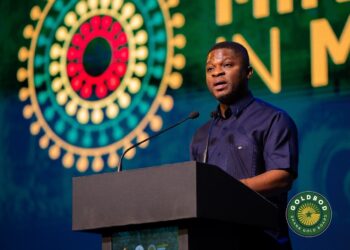
Chief Executive Officer of the Ghana Gold Board, Sammy Gyamfi, has dismissed concerns over the Bank of Ghana’s 2025 financial performance, arguing that reported losses do not warrant significant public debate.
His comments follow the central bank’s release of its 2025 financial statement on May 1, which recorded an operational loss of GH¢15.6 billion — the second highest since the country’s currency redenomination in 2008.
The disclosure has intensified political tensions between the governing National Democratic Congress (NDC) and the opposition New Patriotic Party (NPP).
Speaking on Newsfile, Gyamfi rejected criticism from the opposition, insisting the losses reflect calculated policy interventions rather than economic mismanagement.
However, Gideon Boako, Member of Parliament for Tano North and a member of Parliament’s Finance Committee, described the figures as “a new low,” attributing them to avoidable policy errors. He argued that the losses were particularly concerning given the absence of a major economic crisis in 2025.
Defending the central bank, NDC officials maintain that the financial outcomes stem from deliberate strategies aimed at stabilising the economy. At a press briefing on April 30, Majority MP Atta Issah said the reported costs were tied to measurable economic gains.
“The institution carried them on its books; the country received the benefits,” he said.
According to the Bank of Ghana, the losses were driven largely by monetary policy operations, a gold accumulation programme, and exchange rate-related accounting adjustments.
The gold programme alone accounted for approximately GH¢9 billion in costs. Officials stress, however, that this does not constitute a realised loss, as about 111 tonnes of gold remain held as reserve assets.
Exchange rate movements also significantly impacted the accounts. The bank recorded a GH¢19.32 billion charge in other comprehensive income, reflecting valuation changes linked to the cedi’s 41 percent appreciation in 2025, which reduced the local currency value of foreign reserves.
Gyamfi further distinguished the central bank’s performance from that of the Ghana Gold Board, noting that the latter generated over GH¢960 million in revenue against less than GH¢120 million in expenditure, positioning it to post a surplus.
He also defended BoG Governor Johnson Asiama, describing the costs associated with the gold-for-reserves initiative as intentional policy outcomes rather than indicators of mismanagement.
Meanwhile, the NDC Majority maintains that the Bank’s negative equity predates 2025, tracing it back to 2022 and linking it largely to the Domestic Debt Exchange Programme.
Despite ongoing debate, government officials insist the Bank of Ghana remains operationally sound and capable of fulfilling its core mandate.


BoG Losses Not Cause for Alarm, Says Sammy Gyamfi Amid Political Dispute

Related Posts





Leave a Reply








ADVERTISEMENT

The New Crusading Guide is a privately own newspaper in Ghana with Mr ABdul Malik Kweku Baako as its Editor in Chief. We give you the latest news